Which Coil Size Is Best for UK Pasture Soil?
As an Amazon Associate we earn from qualifying purchases. Some links on this page are affiliate links, which means we may earn a small commission if you make a purchase.
Pasture soil is fundamentally different from cultivated land: the ground is never turned over by a plough, so any metal objects dropped on its surface over decades or centuries settle into the soil matrix and sink slowly deeper. This fixed constraint means your coil choice isn’t about chasing pure depth, but about managing the signal clarity needed to hear those settled targets through the background mineralisation that pasture ground often holds.
Quick picks
- Stock 10-inch coil, UK pasture? Minelab Vanquish 340 — ships with a V10 coil that matches this size band. Check Amazon price →
How Coil Size Affects Detection
A search coil works by generating a magnetic field. The size of this field determines how much ground it interacts with at once. A larger coil covers more area per sweep, but it also reads a larger volume of mineralised soil simultaneously. In UK pasture conditions, this increased interaction often creates a constant low-level chatter that can mask the sharper signals from smaller, deeper targets. It’s the difference between listening for one voice in a quiet library versus trying to pick out the same conversation on a noisy factory floor.
📺 Watch: A comprehensive look at Search Coils #metaldetecting #uneartheduk — Unearthed Detecting TV
The Case for Smaller Coils (4.5″–8″)
Smaller coils are precision instruments. Their main strength is target separation—the ability to distinguish between multiple close-together objects. This makes them excellent for searching areas littered with modern trash or dense iron contamination, where a larger coil would produce a constant, unreadable signal. Their narrow field allows you to pick out individual finds that would otherwise be lost.
The trade-off is depth. A small coil’s magnetic field simply doesn’t penetrate as far into the ground. In clean pasture where the goal is to find older, deeper items, this limitation becomes significant.
Why 10–11″ Coils Work Best on Pasture
The medium coil size strikes the necessary balance for most UK pasture. It provides a meaningful increase in depth over smaller coils without becoming so large that it’s overwhelmed by ground mineralisation. Many detectors, like the Minelab Vanquish 340 (paid link), come with a 10-inch coil as standard because it is the most practical starting point for typical conditions. You get enough depth to reach settled targets while the detector’s ground balancing can still effectively filter out the soil’s background noise.
View Minelab Vanquish 340 on Amazon → (paid link)
For the detectorist focusing on pasture, this size delivers reliable performance without the frustration of constant falsing. It covers ground efficiently while remaining sensitive to coin-sized objects at the depths where they are most commonly found.
The Reality of Large Coils (12″ and Over)
Large coils can detect deeper targets in theory, particularly in low-mineral environments like some dry beaches. On mineralised pasture, however, their advantage often vanishes. The substantial increase in surface area means the coil is constantly receiving a strong signal from the ground itself. To compensate, the detector must apply aggressive filtering, which can reduce its sensitivity to the very smaller, fainter targets you’re trying to find. You might gain a theoretical inch or two of depth on a large object, but risk missing a hammered coin sitting just a few inches down.
Coil Shape and Configuration
The design of the coil is as important as its size. A Double-D (D-D) coil is generally superior to a concentric coil for mineralised ground. Its field pattern is better at cutting through the interference, providing a more stable signal. An elliptical coil offers a compromise, giving some of the manoeuvrability of a smaller coil with the coverage of a larger one. For UK pasture, a round Double-D coil around 10-11 inches tends to be the most consistent performer.
Choosing for Your Conditions
Your choice should be guided by the specific pasture you detect most often. If the ground is highly mineralised, leaning towards the smaller end of the 10-11 inch range can improve stability. If the soil is milder, you might comfortably use a coil at the larger end. Remember that effective depth is the depth at which you can still hear a clear signal, not the maximum depth the coil is technically capable of achieving in ideal conditions.
Frequently Asked Questions
Can I use a small coil on a beach? Yes, small coils are very effective in the wet sand zone and around rock groynes where manoeuvrability is key. Their depth limitation is most noticeable in large areas of dry sand.
Is it easy to switch coils on a detector? Most modern detectors have interchangeable coils, but compatibility is model-specific. Always check with the manufacturer before buying an additional coil.
What’s the main advantage of a Double-D coil? Its field configuration is inherently better at rejecting signals from mineralised soil, making it the preferred choice for most inland detecting in the UK.
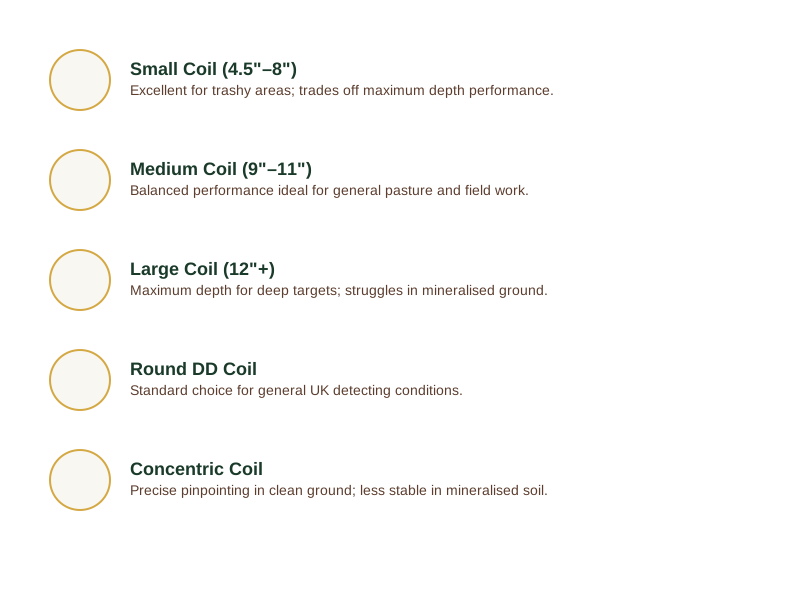
In summary, small coils (4.5"–8") are best for trashy ground and target separation, but have shallow depth penetration. Medium coils (9"–11") are the recommended choice for general pasture detecting. Large coils (12" and over) can be used on low-mineral ground for deep targets, but they offer poor performance in mineralised soil.
Final Recommendation
A 10-11 inch coil remains the most sensible starting point for UK pasture. It provides the right combination of depth and signal stability. Before focusing on equipment, however, make sure your land permissions are secured—the best coil in the world is useless without a legal place to use it.
Get the Free Metal Detecting Permission & Reporting Checklist to handle the essential groundwork before your next detecting session.
Technical References
Explore More Topics
Go deeper on specific topics:
- Do You Need a Pinpointer for Metal Detecting?
- Best Digging Tools and Finds Pouches for Metal Detecting UK
- Headphones for Metal Detecting: Do You Actually Need Them?
- Metal Detector Coil Sizes: What Each Size Does Well
As an Amazon Associate we earn from qualifying purchases.
On heavy clay pasture that sees a wet winter, the ground’s conductivity can change significantly, making a medium coil’s stability even more valuable. This guide offers general technical information. Always verify equipment specifications with manufacturers and ensure you have proper permissions for detecting activities.