How Deep Can a Metal Detector Find Coins in UK Soil?
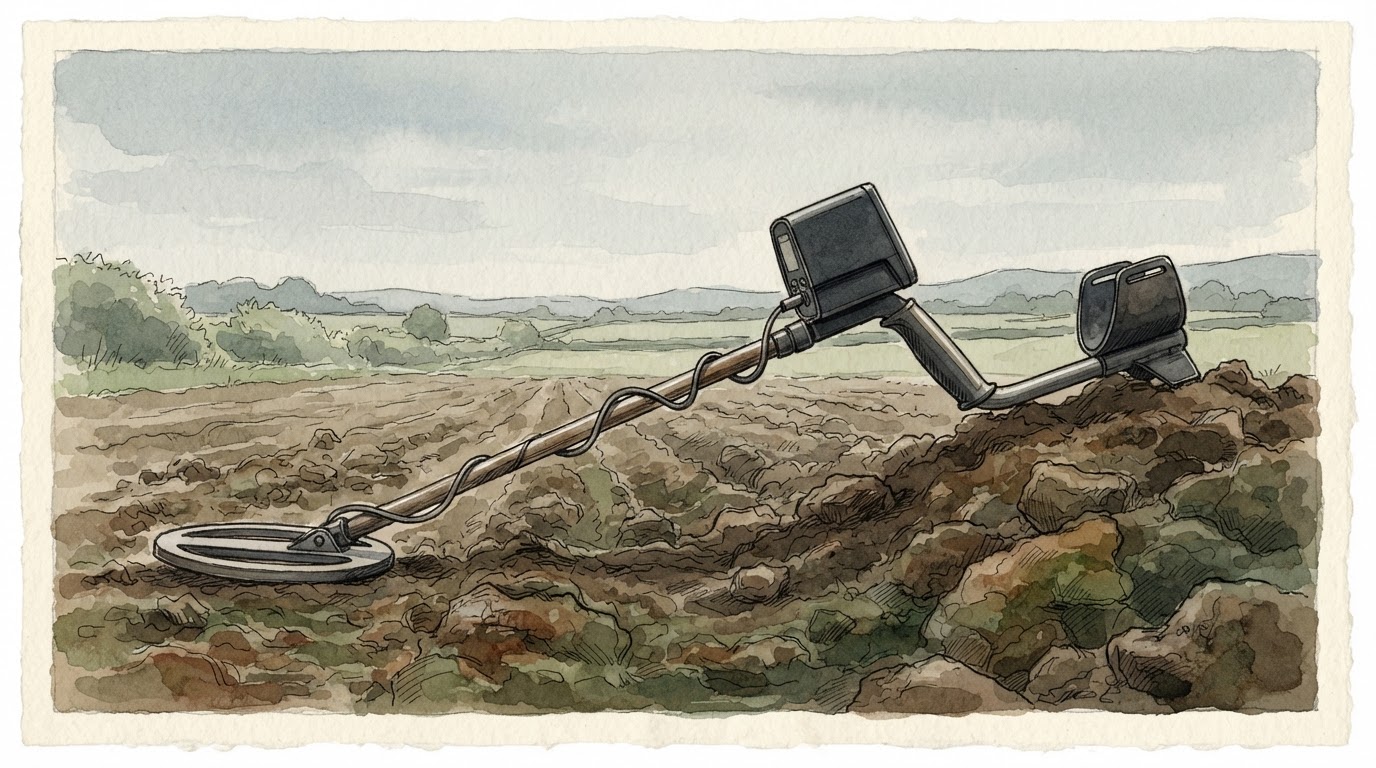
Electromagnetic induction signal strength drops with the square of the distance from the coil. For a small target like a hammered silver penny, roughly 18mm across, this physical law means a faint signal can be overwhelmed by background ground minerals just a few inches down. That’s why ‘maximum depth’ is always a function of the coin’s size, not just the machine’s power.
While detectorists often chase a single depth figure, the reality is a negotiation between your equipment, the ground conditions, and the target’s properties. Understanding this interplay is more productive than comparing manufacturer specifications.
Ground conditions dictate your range
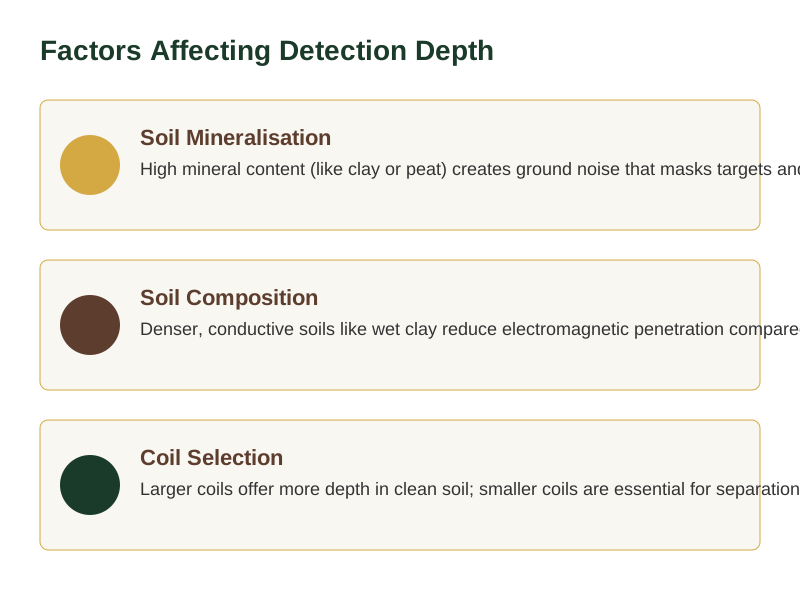
UK soils vary dramatically in their electrical conductivity. Chalk and sandy soils are relatively ‘quiet’, allowing signals from deeper objects to travel with less interference. In contrast, clay and peat, particularly when damp, create a high background signal that can mask a coin’s response entirely. This means the same machine will perform differently from one field to the next. A Victorian penny might ring clear at eight inches in dry chalk, while a modern coin could be nearly silent at half that depth in wet clay.
📺 Watch: MINELAB EQUINOX 800, GROUND BALANCING — SID PERRY ADVENTURES
The main controls on detection depth
Soil Conditions are the primary external factor. You can’t change the ground, but you can adapt your approach. Chalkland, common in southern England and parts of Yorkshire, is forgiving. Heavy clay across the Midlands and lowlands presents a challenge, especially when wet.
Coil Size and Type offers the most direct control. A larger search coil, like an 11-inch or 15-inch Double-D, generally detects larger targets deeper in clean ground. The trade-off includes reduced sensitivity to small items like hammered coins and poorer separation in trashy areas. Large aftermarket coils are useful on open pasture but tiring over long sessions. A smaller coil (9-inch or less) sacrifices theoretical depth for better target separation and clarity in cluttered ground. For general use on UK farmland, an 11-inch Double-D coil is widely considered the best balance, providing sufficient depth for most coin targets, good ground coverage, and manageable weight. If your site is known for small, hammered coins or is littered with modern trash, a smaller coil will improve your results.
The Target Itself completes the equation. A large silver crown has more metal mass and gives a stronger signal than a tiny cut quarter. Depth ratings are typically based on ideal, larger test targets, which doesn’t reflect hunting for small, worn coins in complex ground. It’s also important to remember that the Treasure Act 1996 defines treasure based on the object’s age, material, and context, not its depth; a shallow find can be just as historically important and must be reported to your local Finds Liaison Officer within 14 days.
The practical trade-off: depth versus usability
Focusing solely on maximum depth comes at a cost: you sacrifice ground coverage, sensitivity to smaller finds, and often, physical comfort. Running a large coil slowly to gain an extra inch means covering less area. In iron-infested or littered sites, target identification becomes difficult. The physical weight of a large coil and a sturdy digging tool can lead to fatigue, reducing overall effectiveness.
For most UK farmland, an 11-inch Double-D coil represents a sensible compromise. It offers good sweep width, decent depth for typical coins, and remains sensitive enough for smaller finds. On a trashy park or iron-rich site, switching to a smaller coil will likely yield more actual finds, even if the deepest possible signal is shallower.
Common misconceptions about detection depth
Myth: Higher price guarantees greater depth. While advanced detectors offer better features, no machine overrules difficult ground. A premium model will still struggle in wet clay where mineralisation overwhelms the target. The limitations of capable starter detectors in active soils are a factor of physics, not cost.
Myth: Cleaning a find affects its detectability. Cleaning alters a coin’s surface and can damage its historical value, but it doesn’t change its fundamental metallic properties. A coin’s detectability is fixed by its size and composition when buried. Aggressive cleaning, however, can strip patina and complicate identification by an expert.
UK soil types and their impact
| Soil Type | Typical Mineralisation | Impact on Detection | Suggested Coil Approach |
|---|---|---|---|
| Chalk | Low | Allows for clearer, deeper signals | Larger coils (11"+) perform well |
| Sand | Low | Good depth potential in clean areas | Medium to large coils |
| Clay | High, especially when wet | Masks signals, reduces effective depth | Smaller coils (9"-11") often better |
| Peat | High, electrically active | Very challenging for deep target detection | Small coils recommended |
| Mixed Agricultural | Variable | Highly dependent on recent weather and composition | A versatile 11-inch Double-D is a safe bet |
Matching equipment to the land
Effective detecting means matching your equipment and expectations to the ground you’re on. Depth is a useful capability, but it’s just one part of a larger equation that includes target separation, swing speed, and your own stamina. The detector that gives you the best overall result is the one suited to your specific conditions. It is also crucial to confirm land ownership and obtain permission. For example, on Crown Estate foreshore, metal detecting is generally permitted without formal consent, subject to their published terms, but for other beaches, always check ownership with the local authority or relevant entity, as bylaws can differ significantly.
Most detectorists assume deeper is always better, but in reality, the majority of worthwhile finds are often found in the top few inches. Before fine-tuning for depth, ensure you have the foundational element sorted: confirmed permission to be on the land.
A detectorist who understands why signals weaken at depth is better placed to explain to a landowner why certain fields are worth revisiting after ploughing, or why a ‘quiet’ patch might hold more promise than it seems. This knowledge helps build the trust needed to secure permissions. Use our step-by-step guide to get it right: Get the Free Metal Detecting Permission & Reporting Checklist .
Further reading and official sources
- National Council for Metal Detecting (NCMD): https://www.ncmd.co.uk/
- Portable Antiquities Scheme (PAS): https://finds.org.uk/
- Treasure Act 1996: https://www.legislation.gov.uk/ukpga/1996/24/contents
Related Guides
For a complete overview, see our Why Does My Metal Detector Keep Giving False Signals? .
This article offers general guidance. For definitive advice on legal obligations or specific site conditions, consult the relevant authorities or a professional.