Do You Need Insurance to Metal Detect in the UK?
When a farmer considers a metal detecting request, their immediate concern isn’t the legalities of the search itself, but who bears the cost if something goes wrong. If a cow breaks a leg in a poorly reinstated hole, who pays? This practical question about liability, not the finer points of the Treasure Act, is why insurance becomes a condition of access.
While not a legal mandate, showing up without cover is a fast way to get a ’no’. For organised digs, it’s often a condition of entry. This guide explains the options and why, for most detectorists, joining the National Council for Metal Detecting (NCMD) is the straightforward choice.
The Legal Position on Insurance
The right to search isn’t licensed by the government. The Treasure Act 1996 focuses on reporting finds, not granting permission to detect. However, the absence of a formal licensing scheme shifts the burden of proof onto you.
Insurance operates in a separate, practical sphere. It’s not a legal requirement for individuals, but it’s a standard request from landowners and clubs. The NCMD Code of Conduct explicitly links the two: without permission, you have no right to detect and your insurance cover is invalid. Secure the landowner’s agreement first; your insurance then acts as a backstop for protection.
Your Main Option for Cover
A common route to public liability insurance is through membership of the National Council for Metal Detecting (NCMD). The other traditional provider, the Federation of Independent Detectorists (FID), is no longer accepting new members or renewals for 2026 onwards, honouring existing memberships only until the end of 2025 [1].
NCMD membership currently costs £8 for a single year, with discounts for longer terms (£15 for two years, £22 for three) [1]. It includes £10,000,000 of public liability cover with no excess [1]. Many farm tenancy agreements specify a minimum level of cover, and this figure comfortably meets those requirements.
If you plan to detect outside the UK, check NCMD’s specific overseas terms directly.
What Public Liability Insurance Protects Against
This insurance protects you if you accidentally cause injury to someone else or damage their property while detecting. For example, if you were to damage an underground pipe or cause livestock to injure themselves, you could face a civil claim for the costs. Public liability insurance covers you for third-party property damage and injury claims, handling related legal costs and compensation, up to its limit [2]. Without it, you’d be personally liable, which is precisely why proof of cover is requested.
It does not cover the value of your finds, theft of your detector, or damage to your own equipment. This insurance is a safeguard against claims from third parties, not a guarantee for your hobby’s rewards.
In short, membership cover is a safety net for incidents on someone else’s land. Responsible conduct—getting permission, filling holes neatly, and reporting finds correctly—is what maintains the hobby’s reputation.
The Foundation: Securing Permission
Insurance and permission are connected, but permission is the absolute foundation. The NCMD Code of Conduct is unambiguous: no permission, no cover, and no legal right to detect [3]. You’re on the land because the owner agreed, not because an insurance policy allows it. There is no government-issued detectorist licence; you must have landowner permission to search, and carrying public liability insurance is strong best practice to satisfy landowners and clubs.
📺 Watch: The easier way to get metal detecting permissions! — tcDetects
Being able to show your NCMD membership and explain the code of conduct you follow adds a layer of professionalism that builds trust. In this context, insurance gives the landowner confidence that if an accident happens, there’s a policy to handle it. Regarding finds, you can generally keep them unless an item qualifies as Treasure under the Treasure Act 1996. Treasure (certain precious-metal objects, ancient coin hoards, or historically significant items) must be reported [4]. Ownership of ordinary finds is typically subject to your agreement with the landowner. Insurance doesn’t affect this; it’s a separate matter.
A Quick Comparison
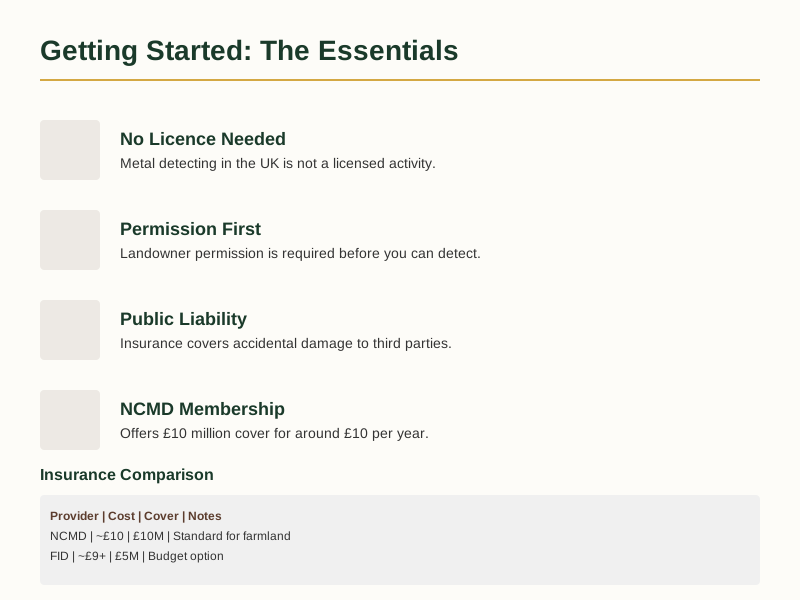
| Provider | Annual Cost | Public Liability Cover | Key Points |
|---|---|---|---|
| NCMD | £8 (1 yr; discounts for multi-year) | £10,000,000 | The standard route; cover is widely recognised. |
| FID | Legacy pricing | £5,000,000 | Not accepting new or renewing members for 2026 onwards. |
| Standalone Specialist Policy | Varies | Varies | Can cover equipment and finds; not included with basic memberships. |
The Three Interlocking Requirements
Insurance, permission, and reporting are three pillars that support responsible detecting. If any one is missing, the entire structure of trust and legality is compromised. Insurance protects against liability, permission grants the right to be there, and reporting fulfils your legal and ethical duties. Covering all three is essential.
If you want to ensure your setup is complete, use the free checklist. It lays out everything you need before your first dig.
Related Guides
For a complete overview, see our Do You Need Permission to Metal Detect in the UK? The Complete Legal Guide .
References & Useful Links
- National Council for Metal Detecting (NCMD)
- Public Liability Insurance Explained
- NCMD Code of Conduct
- Treasure Act 1996
Note: This article offers general guidance. Always confirm specific details with official sources or a qualified adviser.