Why Does My Metal Detector Keep Giving False Signals?
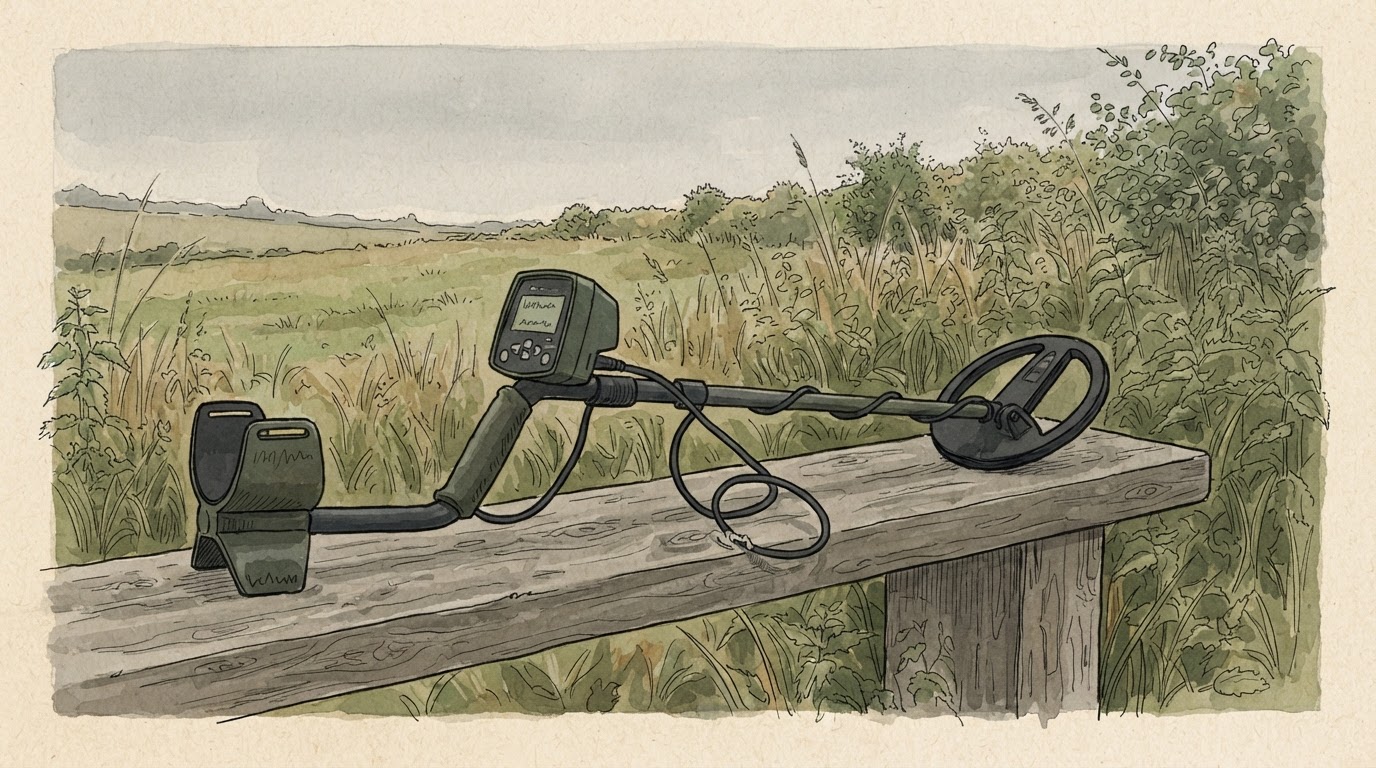
A metal detector’s inconsistent performance—signalling a target on one sweep and static on the next—can feel like equipment failure. In reality, this pattern usually indicates a calibration mismatch between the machine and the specific electromagnetic properties of the ground you’re searching.
Phantom alerts typically stem from three areas: electromagnetic interference, incorrect equipment settings, or the specific mineral composition of the soil. While it’s tempting to blame the machine, the solution usually involves recalibrating it for the environment rather than replacing it.
Three potential causes for false signals
A detector alerting without a genuine target points to one of three common culprits. Beginners often suspect equipment failure, but external factors are more common.
Electromagnetic interference (EMI) happens when external signals disrupt your detector’s operation. Sources include overhead power lines, mobile phones, other nearby detectors, or Wi-Fi routers. The key indicator is interference that is location-specific and disappears when you move away.
Ground mineralisation is a common cause across UK detecting sites. We’ll explore this in detail shortly as it’s often the central issue.
Settings and setup problems include sensitivity set too high, poorly configured discrimination, or a loose coil cable that moves during swings. Even minor cable movement can generate phantom signals.
Use this quick diagnostic to pinpoint the problem:
- Random signals across a wide area? → Probably EMI or mineralisation.
- Signals only occur near buildings or power lines? → Likely EMI.
- Signals intensify in specific patches of a field? → Probably mineralisation.
- A consistent signal over the exact same spot? → Likely a real target – dig it.
Before troubleshooting further, ensure you have the necessary landowner permission to detect on private land, as the NCMD states: “Do not trespass. Obtain permission from the landowner before venturing on any land.” If you’re detecting in parks or public spaces, verify the local regulations.
Why UK soils trigger false readings
For detectorists across Britain, ground mineralisation is a frequent source of false signals. Your detector creates a magnetic field and measures returning “eddy currents” from conductive materials. While coins and artefacts produce these currents, so does iron oxide – the compound that colours much of the UK’s soil.
Areas with limestone, clay, or ironstone geology are particularly problematic. Pasture land, ploughed fields with decades of disturbance, and old hedgerow bases where drainage concentrates minerals can all trigger false readings. Your detector isn’t malfunctioning – the ground itself is genuinely reactive.
Ground balance circuits exist to cancel out this mineralisation, but they can be overwhelmed when conditions change abruptly. Moving across field boundaries, encountering different soil types, or passing over buried features can throw off the calibration. The detector continues reading mineralised soil as targets because its settings no longer match the environment.
Recalibrating your ground balance for the current conditions is the most effective solution. This process, typically involving a button sequence while the coil rests on clean ground, teaches your detector to ignore the specific soil signature.
When detecting on permitted land, remember that significant finds may fall under the Treasure Act 1996. Official guidance states that treasure finds must be reported within 14 days of discovery. Proper ground balancing helps you identify genuine targets that could be reportable.
A step-by-step method for stable detection
Follow this sequence to eliminate false signals. Most issues are resolved at the first step.
📺 Watch: MINELAB EQUINOX - GROUND BALANCING tips for mineralised soils — Henri Eighth
Start by recalibrating ground balance. Since mineralisation is a common cause, this should be your initial action. The process varies by model but generally involves holding the coil steady on bare ground while activating the balance function. Consult your manual. When signals worsen in a new area, recalibrate before trying other fixes.
Check for electromagnetic interference. Switch off your mobile phone and move away from obvious power sources and structures. If other detectors are operating nearby, increase your distance. Unlike mineralisation, EMI is temporary and location-dependent.
Adjust sensitivity as a last resort. If balancing and EMI checks don’t help, lower the sensitivity setting slightly. This trade-off sacrifices a little depth for greater stability in difficult ground. Also, ensure your coil cable is securely fastened, as movement during swings can create false signals.
A buildup of mineralised soil on the coil can also cause interference. While not the first step, regular cleaning does reduce spurious signals as part of a good maintenance routine. If problems persist after these steps, check for this buildup, though it is rarely the primary solution.
With stable detection achieved, having the right recovery gear becomes more important. A pinpointer speeds up target retrieval, while quality digging tools handle tough ground.
Challenging environments and legal restrictions
Some locations present inherent difficulties where detection becomes impractical without specialised equipment or approaches.
Black sand beaches contain such high iron concentrations that standard detectors struggle considerably. Experienced beach hunters use specialised modes, but beginners may find these spots overwhelmingly problematic.
Former mining areas and industrial sites often have mineralised subsoil that mimics target signals. While re-balancing helps, the poor signal-to-noise ratio can make detecting unproductive.
Urban environments with buried utilities combine EMI and mineralisation challenges. Signals often come from infrastructure rather than desirable finds, and previously disturbed ground complicates discrimination.
Detecting on certain protected sites is legally restricted. Scheduled Monuments are protected by law, and detecting on them without permission is a criminal offence. Sites of Special Scientific Interest (SSSIs) and Ministry of Defence (MoD) land also have specific access restrictions. These areas often have unusual ground conditions that generate false signals, making them doubly unsuitable for detecting. It is also illegal to detect on private land without permission. The NCMD guidance is clear that permission is required before detecting on any private land, which includes parks, woods, common land, and public footpaths. This is what separates legal detecting from trespass.
Regarding valuable finds, the Treasure Act 1996 requires reporting finds that meet the treasure criteria within 14 days. Contact your local Finds Liaison Officer via the Portable Antiquities Scheme for guidance. If you are unsure whether an item qualifies, consult your FLO before cleaning or handling it extensively.
Troubleshooting in practice
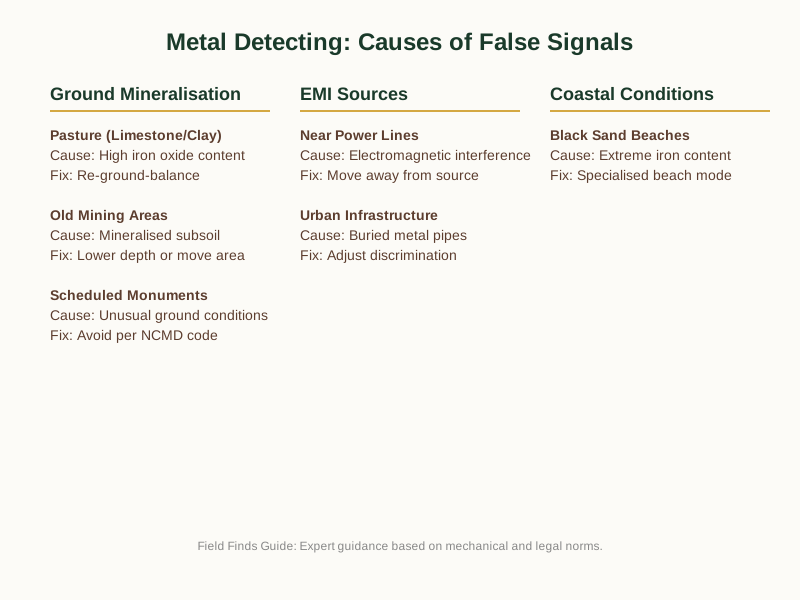
| Condition | Primary Cause | Recommended Approach |
|---|---|---|
| Pasture on limestone/clay | High iron oxide content | Re-balance on a fresh patch of soil |
| Near power infrastructure | Electromagnetic interference | Increase distance from source or turn phone off |
| Black sand beaches | Extreme iron concentration | Use beach-specific modes or specialised gear |
| Former mining areas | Mineralised subsoil | Accept reduced depth or relocate |
| Urban settings | Buried utilities and EMI | Check for interference and adjust settings accordingly |
| Protected sites | Archaeological significance | Avoid detecting as per legal restrictions |
Moving from troubleshooting to productive detecting
If your detector gives persistent false signals after you’ve recalibrated and checked for interference, the issue is likely with the site, not the equipment. Recognising this distinction—between a technical fault and an unworkable patch of ground—is what separates productive sessions from wasted ones.
Once your detector is performing reliably, the next priority is ensuring you operate within the law. Our free metal detecting permission and reporting checklist outlines landowner requirements, Treasure Act obligations, and reporting procedures in clear terms.
For further information, consult these official resources:
Explore More Topics
Go deeper on specific topics:
- Why Is My Metal Detector Not Finding Anything?
- How Deep Can a Metal Detector Find Coins in UK Soil?
- Metal Detector Battery Problems: Why Your Detector Keeps Dying
This article offers general guidance. Always verify specific legal requirements and technical procedures with official sources or qualified professionals.