What Happens If You Don't Report a Treasure Find in the UK?
Under the Treasure Act 1996, the Crown’s title to qualifying finds is automatic at the moment of discovery—not at the moment of reporting. This means a detectorist who delays reporting is already in possession of Crown property, making any potential fine secondary to the underlying legal reality of ownership.
The maximum penalty for failing to report treasure is a level 5 fine, currently £5,000. Combined with the Crown’s power to claim the find without compensation, this creates genuine financial and legal exposure.
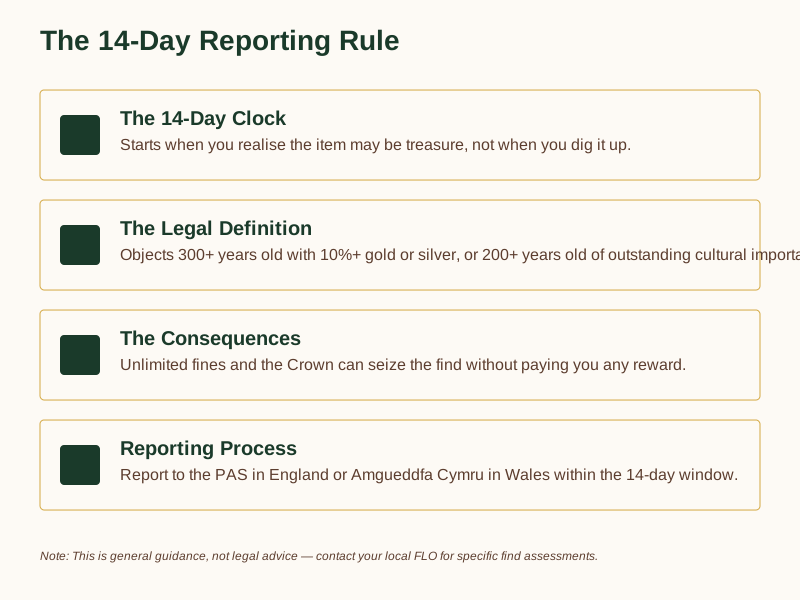
The 14-day reporting obligation begins when you realise an item may be treasure, not necessarily from the moment of discovery. This distinction often catches people out. Missing the deadline creates two distinct problems: you commit a criminal offence punishable by a fine, and the Crown can claim the find without paying a reward.
When the clock starts ticking
Section 8 of the Treasure Act establishes the 14-day deadline, beginning when you first recognise an item’s potential significance. If you unearth something on Saturday but only appreciate its importance the following Tuesday, your countdown starts on Tuesday.
Coroners can grant extensions, but you must request this before the deadline expires. The National Council for Metal Detecting’s code emphasises that reporting treasure is a legal duty separate from any landowner agreement.
When unsure whether an item qualifies, report it. Finds Liaison Officers can advise before formal submission, and reporting something that turns out not to be treasure carries no penalty. The risk lies entirely in failing to report qualifying finds.
What counts as treasure today
The legal definition has expanded significantly in recent years. Since 2023, treasure isn’t limited to precious metals—any historically important object over 200 years old may trigger reporting duties.
Precious metal objects: Items at least 300 years old containing 10% or more gold or silver. This traditional definition covers coins, jewellery, and hoards.
Historically significant objects: Exceptional items over 200 years old that provide important insight into national heritage, regardless of metal content. Bronze artefacts or culturally significant objects can now qualify.
Associated finds: Objects discovered together with a treasure item. Treat any group find as potentially reportable until assessed.
When uncertain, consult a Finds Liaison Officer for guidance on whether your find meets the criteria. It is important to note that you cannot keep an item that meets the legal definition of treasure, even if you do not report it, as the Crown’s claim takes precedence. For non-treasure finds, you may be able to keep them, though recording archaeologically significant items remains good practice. The reporting obligation applies regardless of whether the treasure was found on private land; landowner consent for detecting is separate from Treasure Act requirements.
Consequences of missing the deadline
Failure to report treasure within 14 days is a summary offence under Section 8 of the Treasure Act. The maximum penalty is three months’ imprisonment or a level 5 fine.
Beyond the fine, the Crown retains the right to claim the treasure. While imprisonment is rare, the combination of financial penalty and forfeiture makes non-reporting genuinely costly.
The law applies regardless of land ownership or private agreements. The misconception that “finders keepers” applies on private land doesn’t survive contact with the legislation. Reporting protects both your legal position and potential entitlement to a reward.
How to report your find
The reporting process is straightforward but time-sensitive. Submit clear photographs and precise findspot details, including coordinates, through the appropriate reporting service.
Contact your local Finds Liaison Officer immediately if you’re uncertain about a find’s status. They exist to help determine whether items require reporting, protecting both the archaeological record and your legal standing. For example, not all old coins require reporting; only those at least 300 years old with 10% precious metal content. A Finds Liaison Officer can help determine whether formal reporting is necessary.
Take finds to a Finds Liaison Officer or museum in person rather than posting them. Context information is archaeologically crucial, and direct assessment is necessary before formal processing.
Now you understand the reporting requirements—Get the Free Metal Detecting Permission & Reporting Checklist to ensure you’re fully prepared before your next outing.
Understanding the legal framework
| Category | Minimum Age | Metal Requirement | Additional Criteria |
|---|---|---|---|
| Traditional treasure | 300 years | 10% gold or silver | Applies to coins and artefacts |
| Significant objects | 200 years | Any metal | Must be of outstanding historical importance |
| Associated finds | No age limit | No requirement | Found with or near qualifying treasure |
Final considerations
The 14-day window is so short that a detectorist who doesn’t know the Treasure criteria before they dig is already at risk of missing it—making pre-dig knowledge the practical protection against legal exposure.
Related Guides
For a complete overview, see our What Counts as Treasure Under UK Law? The Treasure Act 1996 Explained .
This article provides general information. For specific legal advice concerning treasure finds, consult the relevant authorities or a qualified professional.