Headphones for Metal Detecting: Wired vs Wireless
As an Amazon Associate we earn from qualifying purchases. Some links on this page are affiliate links, which means we may earn a small commission if you make a purchase.
When your detector’s speaker is on, everyone nearby hears it. On open pasture, that means the landowner whose permission you want to renew can hear every signal you find. The question of headphones, then, starts with who else is listening, before you even consider how to better hear faint tones yourself.
Quick picks
- Wired, no charging? Garrett MS-2 — coiled cord, works with most 1/4-inch jacks. Check Amazon price →
- XP Deus or ORX? XP WSAUDIO — wireless into that system. Check Amazon price →
Headphones aren’t about making quiet sounds louder—they’re about eliminating the wind noise that masks the threshold tones essential for target identification. At the high sensitivity settings needed for depth, wind creates a constant roar over the speaker, turning precise equipment into guesswork.
This guide examines how headphone design tackles wind interference and helps you select the right audio solution for your detecting environment.
The Real Problem: Why Wind Ruins Your Signal
Wind noise isn’t about sound quality—it’s about hearing isolation.
When wind hits the detector’s speaker grille, it creates a constant rushing sound that sits on top of the audio signal. At high gain levels required for deep targets, this wind noise drowns out the faint threshold tones that distinguish iron from foil or coins. Your detector might be working perfectly, but you can’t interpret what it’s telling you.
Headphones solve this by physically blocking wind noise, allowing you to hear the detector’s actual signals clearly. Over-ear designs can also help reduce listening fatigue during long sessions by containing the audio.
Entry-level detectors like the Vanquish, Simplex, or Ace 300i have adequate speaker volume for sheltered conditions like parks or gardens on calm days. The wind noise problem is most acute on exposed sites like open farmland, beaches, and hillsides. If you mostly detect in sheltered spots, you might not need headphones at all. But for exposed locations, they’re essential kit.
Before heading out, remember that getting landowner permission is mandatory. The National Council for Metal Detecting guidance states you must have landowner permission before detecting on any land, including areas with right-to-roam access where detecting is not permitted.
The Case for Wired: Simplicity and Dependability
Wired headphones offer a straightforward, reliable connection. Plug them in and they work—no pairing, no latency, no risk of signal drop. You never worry about batteries dying mid-session, which is crucial when you’re deep into a dig as the light fades.
A well-established wired choice is the Garrett MS-2 (paid link). It’s known for providing a comfortable fit for long sessions, with a lightweight feel and clear sound at a reasonable price point. The coiled cord is a practical feature for field use.
View Garrett MS-2 on Amazon → (paid link)
On wind noise: basic wired over-ear models provide some acoustic isolation through their sealed cups. They reduce wind noise, though not as effectively as some purpose-built designs.
The wired approach wins on reliability, cost, and simplicity. The trade-off is a physical tether and generally less effective wind noise isolation on very exposed sites.
The Wireless Advantage: Mobility and Clarity
Wireless headphones address wind noise primarily through a sealed, over-ear design that blocks wind from reaching your ear. This physical seal provides the essential noise isolation.
The freedom of movement is a significant advantage. No cable snagging on hedgerows or restricting your swing on slopes—you move unencumbered.
For XP Deus or ORX owners, the XP WSAUDIO headphones (paid link) are marketed as a compatible wireless accessory. XP’s documentation confirms pairing support for these models. The stereo audio helps interpret signals in complex ground.
Check XP WSAUDIO headphones price → (paid link)
Drawbacks include the need to manage battery life and the practical risk of forgetting to charge them. The build also feels lightweight compared to more rugged wired options.
Wireless excels in freedom and audio clarity for compatible systems, but requires diligent battery management.
How to Decide: Matching Kit to Your Ground
There’s no single winner—the right choice depends on your specific circumstances and priorities.
Choose wired for reliability and budget-friendliness. No charging concerns. Ideal for beginners or those detecting in sheltered, low-wind environments.
Choose wireless for freedom of movement and superior wind noise isolation. This makes them worthwhile for regular detecting on open farmland or beaches, despite the battery management requirement.
Practical guidance:
- Tight budget, calm conditions, casual use → wired. The Garrett MS-2 (paid link) is a solid, reliable choice.
- Regular detecting, open farmland or beach, XP detector → wireless. The audio benefits and freedom justify the extra care.
- Regular detecting, open farmland or beach, non-XP detector → wireless, but verify connector compatibility first.
If you’re still testing the waters with the hobby, start with wired—it’s a low-risk investment.
Two Reliable Models for UK Conditions
Garrett MS-2
A reliable wired option ideal for beginners. It offers comfort during long sessions, an adjustable fit, and a practical coiled cord. It represents good value for those building detecting habits.
The sound can be slightly muffled—a common trade-off in designs prioritising seal. At a modest price point, it provides low-risk reliability.
XP WSAUDIO
The wireless option for XP system users. Sound quality and convenience are its practical draws. The wireless design offers complete movement freedom.
The compromises are real: build quality feels less robust, and battery dependency means forgetting to charge can leave you audio-less in the field.
These are worthwhile for XP users prioritising audio quality and mobility, provided you maintain charging discipline.
Answering Detectorists’ Questions
Is using headphones a legal requirement?
No. UK metal detecting guidance doesn’t require headphones as a legal condition. The NCMD code of conduct focuses on landowner permission, trespass, reporting obligations under the Treasure Act 1996, and avoiding protected sites. Headphone use is a practical choice, not a legal requirement.
Will any headphones work with my detector?
Most modern detectors use standard connectors. Some premium models, including certain XP configurations, have proprietary connections—XP’s documentation shows model-specific headset pairing. Always check your detector’s manual before purchasing.
Can I use regular Bluetooth headphones?
Compatibility varies. Some detectors may work with regular Bluetooth headphones via a wireless adapter, but specific support depends on your detector’s capabilities. For example, XP detectors like the Deus or ORX are designed to pair with their proprietary WS Audio headphones, not generic Bluetooth models. Always consult your detector’s documentation for accurate information.
Matching Your Situation
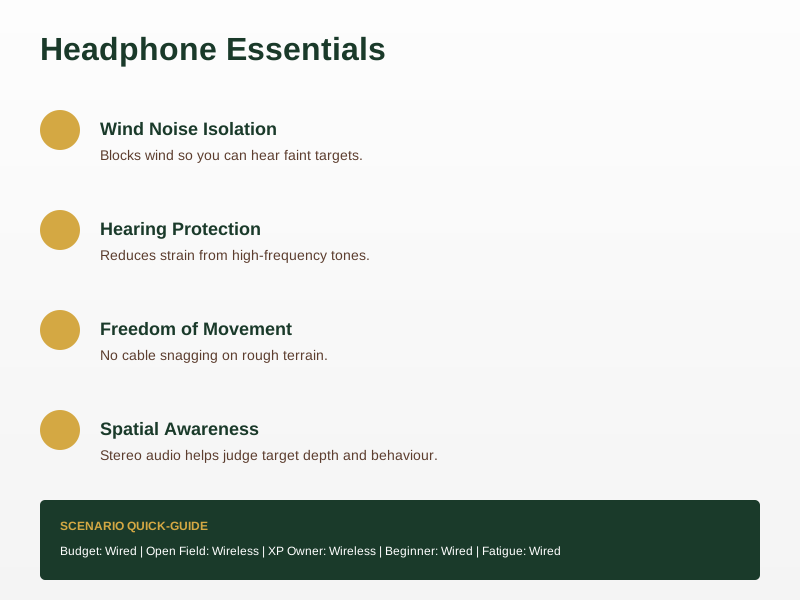
Ultimately, the best choice aligns with your specific situation. For a tight budget or calm conditions, wired headphones are the most reliable and low-cost option. If you detect regularly on open farmland, the wind noise isolation and freedom of movement offered by wireless models are key benefits. XP Deus or ORX owners will find wireless models offer designed compatibility and clear audio. For those still learning the hobby, starting with a wired set is a low-risk investment. Finally, for long sessions where fatigue is a risk, an over-ear design from either category helps by containing audio and reducing ear strain.
Final Considerations for Your Setup
Headphones transform detecting on exposed sites by solving the fundamental problem of wind noise interference. While beginners often focus on hearing faint targets, the real value lies in eliminating environmental noise that masks your detector’s feedback.
The choice between wired and wireless compounds across a season. A wired set forgets nothing but its cable; a wireless pair demands charging discipline but repays you with uncluttered movement. For serious work on open ground, particularly with an XP system, that trade-off tilts toward wireless. For sheltered, casual, or budget-conscious detecting, wired reliability is hard to beat.
Get the Free Metal Detecting Permission & Reporting Checklist to ensure you’re detecting legally and responsibly.
As an Amazon Associate we earn from qualifying purchases.
Related Guides
For a complete overview, see our Coil Size Explained: Which Is Best for Your Soil and Target? .