Is It Illegal to Metal Detect Without Permission in the UK?
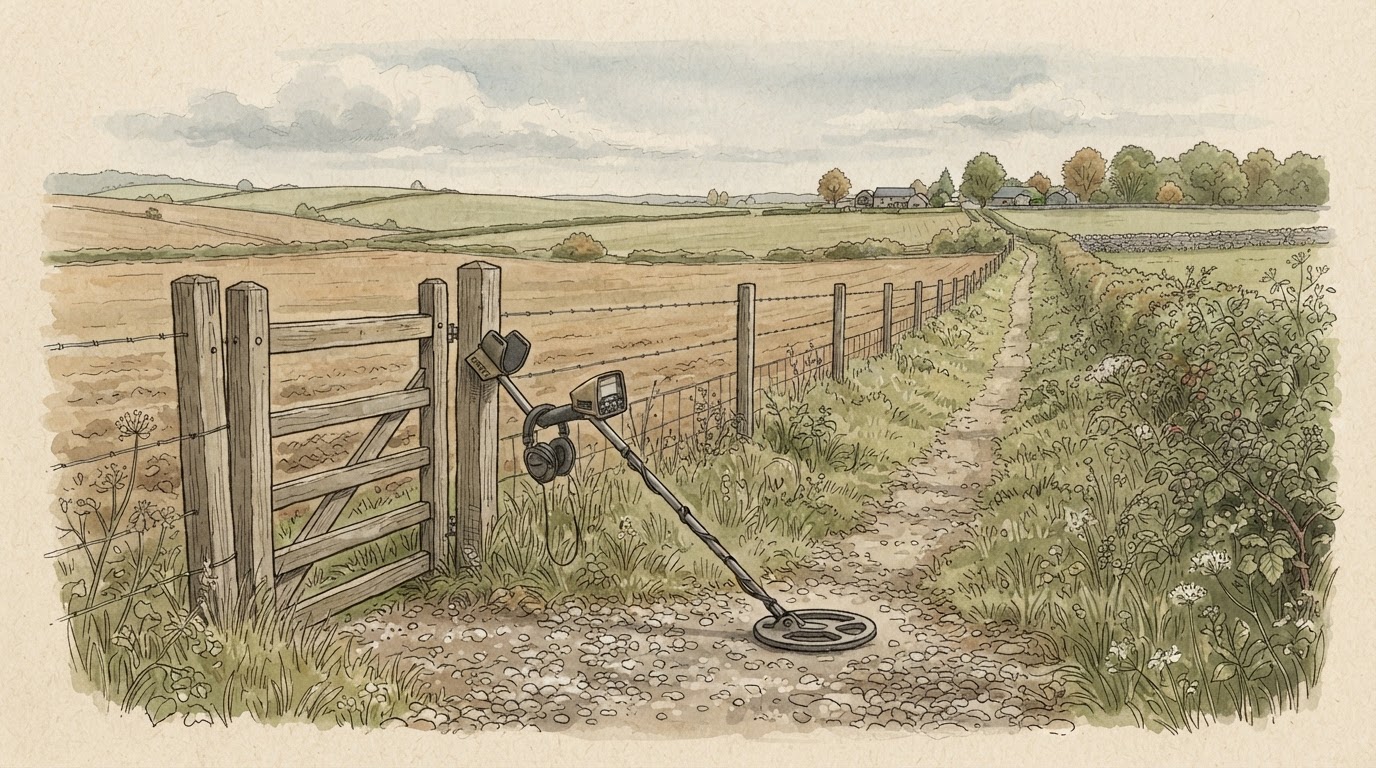
Metal detecting without consent puts you at risk of civil trespass, a matter of tort law where a landowner can sue for damages. But on a site protected by the Ancient Monuments and Archaeological Areas Act 1979, the same action becomes a distinct criminal offence. Many detectorists are aware of the first scenario; far fewer grasp the second statutory regime and its serious consequences.
The distinction between these two legal frameworks—one civil, one criminal—defines the real stakes of searching without authorisation. From a dispute over field access to a prosecution for disturbing a Scheduled Monument, the outcome hinges on the specific ground beneath your feet.
The Legal Framework: Civil Trespass vs. Criminal Damage
The law treats unauthorised metal detecting differently depending on the land’s classification. On most private land, it’s a civil matter. On specifically protected sites, it’s a criminal act.
Trespass: A Civil Wrong In England and Wales, stepping onto land without permission to search with a metal detector constitutes trespass. This is a civil wrong (a tort), not a crime. The landowner can seek compensation for any loss or obtain a court injunction to prevent your return. Police generally have no power to arrest for trespass alone, unless it escalates to aggravated trespass. The detecting community considers going without permission a serious breach of conduct.
Criminal Offences on Protected Land The legal picture changes completely on designated sites. Using a metal detector on a Scheduled Monument without written consent from the relevant authority (such as Historic England) is a criminal offence under Section 42 of the Ancient Monuments and Archaeological Areas Act 1979. The penalty can be a fine. The offence is one of strict liability in many cases; your intent is largely irrelevant—the act of detecting on the protected ground is what matters.
While detecting on a regular field might only risk a civil dispute, accidentally searching a Scheduled Monument can result in a criminal record. This is why experienced detectorists emphasise the importance of thorough land checks.
Where Permission Is Always Required
Knowing which types of land carry specific restrictions is the first step to staying within the law.
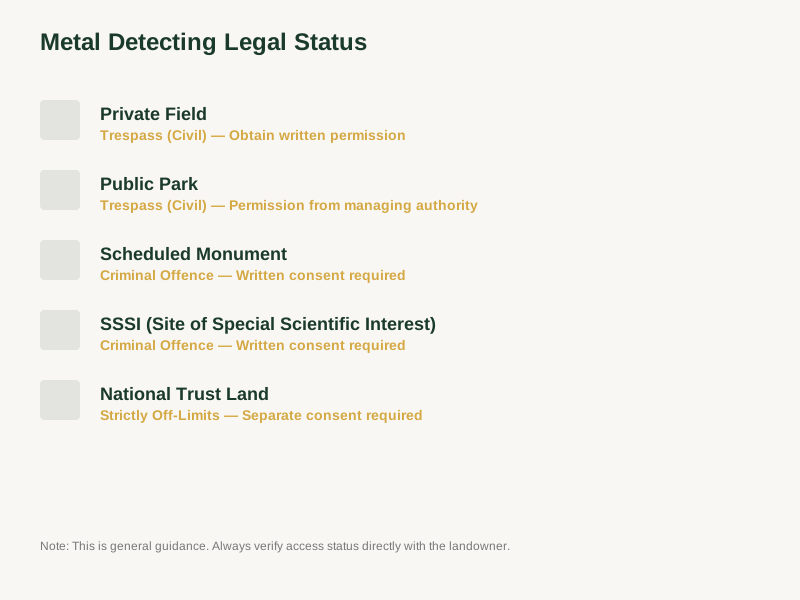
- Private fields and farmland: Civil trespass applies. Obtain written permission from the landowner.
- Public parks and open spaces: You need permission from the managing local authority or the underlying landowner; detecting without it is still trespass.
- Scheduled Monuments: A criminal offence to detect without formal consent from the relevant national heritage body.
- Sites of Special Scientific Interest (SSSIs): These areas are protected for their wildlife, plants, or geology. Detecting may be an offence if it damages the site’s special features, and consent from the appropriate conservation authority (e.g., Natural England) is typically required.
- Land managed by organisations like the National Trust or English Heritage: Access requires specific prior consent, as their policies on detecting vary by individual site.
- Beaches: Ownership varies between local councils, the Crown Estate, and private owners. Always check with the relevant authority for their specific rules. A common misunderstanding involves public footpaths. A public right of way only grants the right to pass along the path; the land itself remains privately owned, and you need the landowner’s permission to metal detect on it. Detecting from the path is still trespass.
A common misunderstanding involves National Parks. While these areas have public access rights for recreation, these rights do not extend to metal detecting. You still need specific permission from the landowner or managing authority within the park.
The challenge is that protected sites aren’t always obvious. A Scheduled Monument might be an unmarked earthwork in a farmer’s field. The only safe approach is to check before you search. Historic England’s online heritage records are the primary tool for this.
Securing Permission: A Practical Guide
Obtaining permission is often straightforward if approached correctly.
📺 Watch: How To Get Farmers Permission 2020 — Yorkshire Relic Hunter
Contact the landowner directly. Whether in person, by phone, or email, be polite and professional. Introduce yourself, explain your hobby, and outline your commitment to following the code of practice, including how you’ll handle any finds.
Get written confirmation. While verbal permission is legally binding, it’s difficult to prove. An email or a simple written agreement provides a clear record for both parties, preventing misunderstandings.
Wait for a definite ‘yes’. Do not begin detecting if you’ve only sent a request and are awaiting a reply. Silence does not constitute permission.
A clear, concise request is usually effective:
Hello, my name is [Your Name] and I live locally. I am a responsible metal detectorist and would like to request permission to search on your land. I am fully insured, adhere to the Treasure Act, and would be happy to share any interesting finds with you. Please let me know if this would be acceptable.
This method is normally successful. Most landowners are reasonable when approached with respect. By securing proper permission, you protect yourself legally and help maintain the hobby’s reputation.
Ownership of Finds: Beyond ‘Finders Keepers’
The “finders keepers” notion is a dangerous myth that leads to disputes.
📺 Watch: Recording your metal detecting finds. Portable Antiquities Scheme — TheManWithTheHat
On private land, the fundamental legal principle is that the landowner owns any objects found, unless a prior agreement states otherwise. This is a standard expectation reinforced by club codes: without a written agreement, a find typically belongs to the landowner. If you find something valuable, and the item qualifies as treasure under the Treasure Act 1996, you must report it. For non-treasure finds on private land, ownership lies with the landowner unless agreed otherwise. On public land, policies vary, so check with the managing authority.
This is separate from the Treasure Act 1996. If you find treasure—defined as gold or silver objects over 300 years old, groups of coins from the same find, or certain prehistoric base-metal artefacts—you have a legal duty to report it to the coroner. The item may then be acquired by a museum. However, this reporting duty doesn’t override the basic rule of landowner ownership for non-treasure finds.
The solution is simple: agree on finds ownership beforehand. Have a clear conversation with the landowner and confirm the arrangement in writing. This prevents confusion and ensures everyone understands their rights.
Summary of Land Status and Requirements
| Land Type | Legal Status | Action Required |
|---|---|---|
| Private Field | Civil Trespass | Obtain written permission |
| Public Park | Civil Trespass | Permission from managing authority |
| Scheduled Monument | Criminal Offence | Written consent from heritage body |
| SSSI | May be an offence if damaging | Consent from conservation authority |
| Organisation-managed land | Typically prohibited | Separate consent required per site |
| Beach | Varies; often requires permission | Check with local authority/owner |
| National Park | Restricted access | Specific permission required |
The Importance of Knowing Before You Go
The practical test for whether a site is scheduled is straightforward: consult the public register that any detectorist can check before visiting—Historic England’s National Heritage List for England. This makes ignorance of a site’s protected status an avoidable, rather than an excusable, position.
For a clear, step-by-step guide to handling permissions and reporting finds correctly, download the Free Metal Detecting Permission & Reporting Checklist . It gives you a reliable framework to begin your hobby the right way.
Essential Resources
Related Guides
For a complete overview, see our Do You Need Permission to Metal Detect in the UK? The Complete Legal Guide .
This article offers general guidance. For specific legal advice, always consult a qualified professional or the relevant official sources.