Is It Legal to Metal Detect on Beaches in the UK?
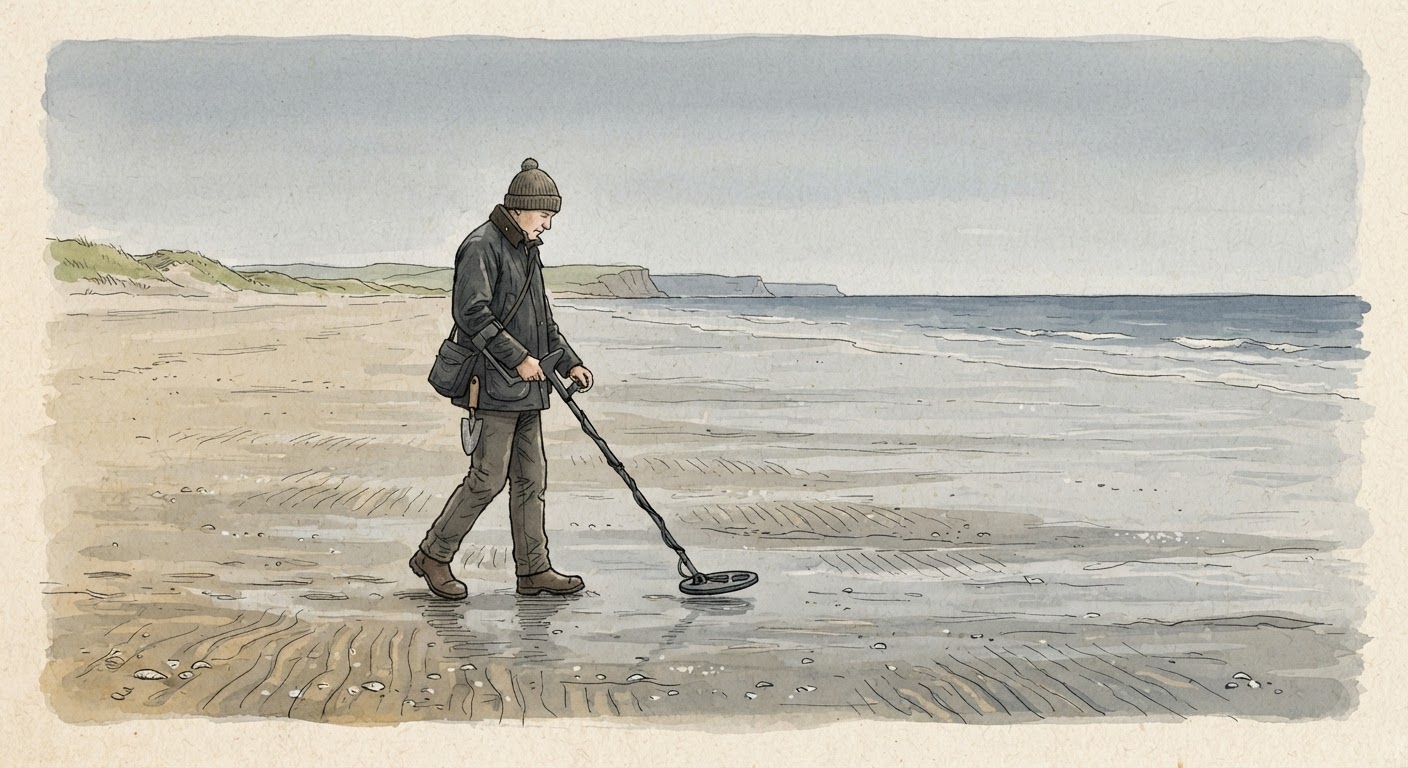
On a sandy UK foreshore, the high tide leaves a visible boundary: a line of dried seaweed, shells and driftwood known as the strandline. This natural marker represents the mean high-water mark, which also forms the legal boundary between the Crown Estate’s permissive detecting rights below it and the private or council-owned land above it. The simple question of where you can legally detect becomes a matter of watching your step.
According to the Crown Estate’s published terms, recreational metal detecting on the foreshore—the land between mean high and low water—may be done without formal consent, subject to their conditions[1]. But step above that tide line onto the dry sand, and you’re likely on land requiring specific permission from a council, private owner, or organisation like the National Trust.
This guide maps the legal terrain. You’ll learn how to identify the tidal boundary, who to contact for dry sand areas, and your reporting duties for significant finds.
Where the Tide Draws the Line
Public access for walking doesn’t grant a right to dig. As the National Council for Metal Detecting (NCMD) guidance states, you must obtain permission before using a detector on any land[2]. Assuming a beach is ‘public’ because you can walk there is a common and costly mistake.
The critical division is between the foreshore, managed by the Crown Estate, and the dry sand above it. Ownership of the upper beach can be complex, involving local authorities, private estates, or conservation bodies, each with its own rules.
Detecting on the Crown Estate Foreshore
The Crown Estate defines the foreshore as the land between mean high water and mean low water[1]. Their policy grants a permissive right for recreational detecting in this zone, provided the activity doesn’t disturb the seabed. No formal application or fee is required.
This makes the foreshore the most straightforward legal starting point. The mean high water mark is your guide—often visible as a change in sand texture or debris line. However, this general permission has limits. Sites of Special Scientific Interest (SSSIs) and scheduled monuments remain completely off-limits, and the Treasure Act 1996 applies to all finds made here[3][4].
Securing Access to Dry Sand Areas
Above the high tide line, the situation changes. While local councils often own this land, you must secure permission from the landowner or their tenant. The NCMD advises getting this consent in writing where possible.
The process usually involves contacting the council’s relevant department (often parks or leisure) to check for any specific bylaws and obtain confirmation. Be aware that management may be delegated to a tenant, so confirming the correct contact is essential.
Restricted Beaches and Protected Land
On beaches owned by the National Trust, metal detecting is generally prohibited outside of organised archaeological investigations. For any privately owned beach, explicit prior consent from the owner is mandatory[5]. Detecting without it constitutes trespass.
The legal consequences are more serious on protected land. If a beach is designated as a scheduled monument or an SSSI, using a metal detector there is a criminal offence, regardless of ownership[4]. Always look for signage and respect these restrictions.
Your Responsibilities Under the Treasure Act
Permission to search is separate from your legal obligations upon a find. The Treasure Act 1996 applies to all finds made in England, Wales, and Northern Ireland[3]. If you discover an object meeting the legal criteria—such as prehistoric base metal assemblages, groups of coins from the same find, or items of precious metal over 300 years old—you must report it.
The law requires reporting potential treasure to the coroner within 14 days, starting the day after the find or when you first believe it might be treasure[3]. Your local Finds Liaison Officer (FLO) from the Portable Antiquities Scheme can assist. While most beach finds are ordinary, the duty for significant discoveries is absolute.
Practical Considerations for Beach Detecting
📺 Watch: Beach metal detecting beginners guide — The skill school
Do I need a permit for beach detecting?
On the Crown Estate foreshore, no permit is needed as a general permission exists[1]. For council-owned dry sand areas, a formal permit system is uncommon, but you must seek permission from the landowner. On private or National Trust land, explicit consent is essential.
Are there time restrictions for detecting?
Always check local regulations. Some beaches have bylaws or permission conditions that restrict detecting times, including prohibitions after dark.
What should I do if I find an old coin?
First, assess if it might qualify as treasure. Coins are typically treasure if they’re part of a group from the same find or are prehistoric. Single coins are usually not treasure unless made of gold or silver. Report any potential treasure to the coroner via the Portable Antiquities Scheme. The FLO will guide you, and you may be eligible for a reward if a museum acquires the find[3].
Beach Zones at a Glance
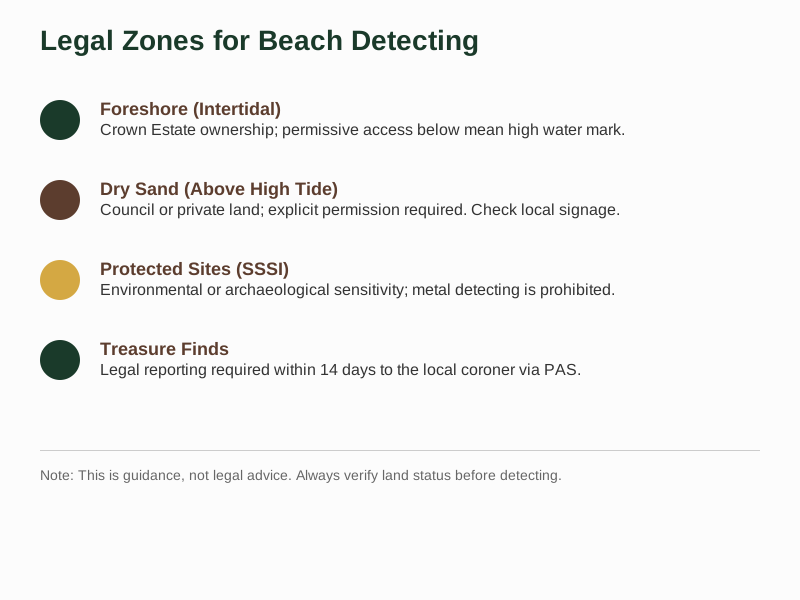
| Zone | Ownership | Permission Required | Key Considerations |
|---|---|---|---|
| Foreshore (Intertidal) | Crown Estate | Permissive (Free) | Valid below mean high water; protected sites are excluded. |
| Dry Sand (Above High Tide) | Council / Private / National Trust | Yes | Always obtain confirmation from the landowner or tenant. |
| Protected Sites (SSSI/Scheduled Monument) | Varies | No Detecting Allowed | Detecting is a criminal offence on these sites. |
| Treasure Finds | N/A | Reporting Required | Report potential treasure to the coroner within 14 days. |
Maintaining Legal Access
Beach permissions are more time-sensitive than farmland agreements. Tidal schedules, seasonal bylaws, and council restrictions can change, making your permission checklist a document to revisit before each coastal trip rather than once at the start of the season.
Use our free checklist to ensure your permissions and reporting knowledge are current for your next visit to the coast.
Related Guides
For a complete overview, see our Do You Need Permission to Metal Detect in the UK? The Complete Legal Guide .
Sources and Further Reading
- The Crown Estate - Metal Detecting
- National Council for Metal Detecting (NCMD)
- Portable Antiquities Scheme (PAS)
Please note: The information in this article is for general guidance. For definitive advice on specific situations, consult the relevant landowners and official sources.