Are Metal Detecting Clubs Worth Joining in the UK?
For a detectorist who already has a written landowner agreement and their own public liability insurance, a club’s membership fee buys little more than social outings. But if you’re missing either of those legal essentials, the annual cost suddenly becomes the price of entry to the hobby itself. This isn’t about whether clubs are ‘good’ or ‘bad’—it’s about which of two distinct routes to a legal detecting portfolio fits your starting point.
The Legal Baseline: Permissions and Insurance
Before considering any club, understand the non-negotiable rules you’ll be bound by regardless. Using a metal detector without the landowner’s consent is trespass. This applies even to parks and common land. The National Council for Metal Detecting (NCMD) is clear: you need permission for any land, and it’s illegal to detect on Scheduled Monuments without specific authority [source ] [source ]. Another common complication arises with tenant farmers; the person working the field might not have the power to grant permission, so you need the freeholder’s approval. Crucially, you also need public liability insurance, which protects you if you accidentally cause damage. These two assets—a signed permission and valid insurance—form the legal foundation. A club’s core function is to supply them if you don’t.
📺 Watch: Detecting Permission, This may help you! — Unearthed Detecting TV
What Clubs Actually Provide
A club’s main asset isn’t training—it’s a pre-packaged legal and logistical framework. Clubs are particularly suitable for beginners who learn by doing rather than through structured lessons.
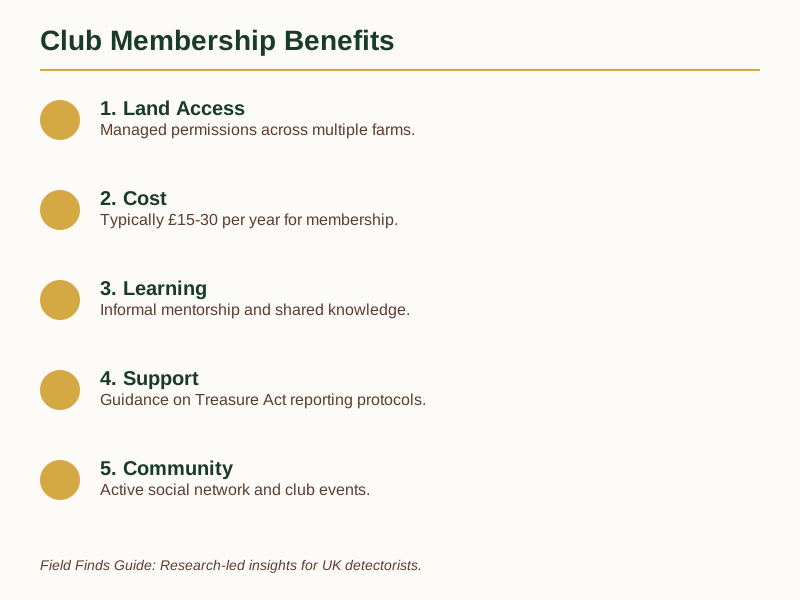
Pre-negotiated land access. Committees spend considerable effort securing permissions with local landowners. This network of farms is the primary draw for new members who otherwise face the daunting task of cold-calling landowners. It’s important to note that these permissions are local to the agreements a specific club has secured. The NCMD, a representative body, provides insurance and resources, not land access, so you must join a club that operates where you want to detect [source ].
Peer support, not formal lessons. Learning happens through observation on group digs, not in a classroom. Some clubs offer a mentor system, but it’s informal. Reports on clubs like Surrey’s, which grew from about 60 members in 2019 to over 3,000 by 2025, show they are often filled with beginners all seeking the same solution [source ].
Secondary benefits. Club digs let you try different equipment. Experienced members can offer immediate advice if you find something unusual, which is helpful given the legal requirement to report treasure within 14 days [source ]. The finder is legally responsible for reporting any treasure, and while club members can advise, you must personally contact the Portable Antiquities Scheme. The social aspect also helps maintain motivation through slow periods. Membership fees vary, so it’s best to contact clubs in your area for their specific rates.
The Solo Alternative: Building Your Own Portfolio
If you already have permissions and insurance, the club model offers less. The membership fee then pays for community and access to different sites, but you lose the freedom to detect on your own schedule. Going solo means you’re responsible for finding land, negotiating terms, and managing your relationship with the landowner. It requires more upfront work but offers complete flexibility.
Which Route Is For You?
Your situation dictates the sensible path.
- Missing permission or insurance? A local club is the most straightforward solution. It turns a major legal hurdle into a simple annual fee.
- Already have both? The value of a club diminishes. Consider whether the community and variety of sites are worth the cost and adherence to a group calendar.
| Aspect | Club Membership | Solo Detecting |
|---|---|---|
| Land Access | Pre-negotiated permissions | Requires individual agreements |
| Cost | Annual membership fee | No direct cost, or payments to landowners |
| Legal & Find Advice | Peer guidance | Self-directed research |
| Equipment | Chance to try shared tools | Relies on your own purchases |
| Social Aspect | Built-in community | Typically solitary |
| Flexibility | Scheduled group digs | Detect on your own schedule |
Your Next Step
- National Council for Metal Detecting (NCMD) – A representative body offering insurance and guidance.
- Portable Antiquities Scheme (PAS) – For reporting finds and research.
- Countryside and Rights of Way Act – The underlying legislation on land access.
Whether you join a club or go solo, you’ll end up with the same thing: a permissions portfolio and the same legal obligations under the Treasure Act. The club route bundles this with a community and a schedule; the solo path demands more initial legwork but offers independence. If you’re building your own permissions from scratch, a systematic guide can help: Get the Free Metal Detecting Permission & Reporting Checklist .
Explore More Topics
Go deeper on specific topics:
Always verify specific landowner permissions and legal obligations with the relevant authorities.