What Is a Metal Detecting Rally and Should You Go to One?
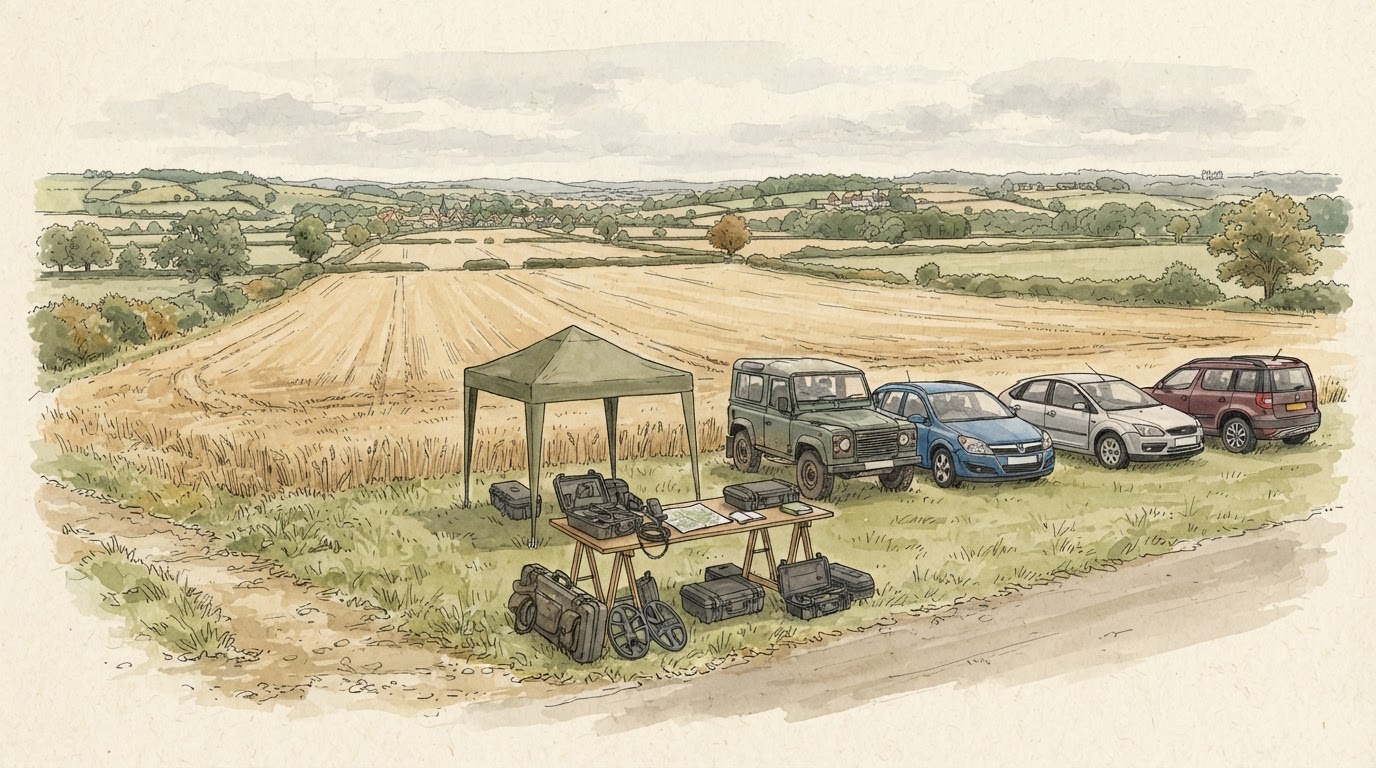
A rally is the one setting where landowner consent, insurance and finds-recording have already been arranged by the organiser. For someone who has not done any of that groundwork themselves, it is the only way to detect legally.
An organiser—usually a club or experienced individual—secures temporary land access and sells tickets. This pre-arranged framework provides a managed environment for newcomers to practise responsible detecting.
The managed environment
At its heart, a rally is an organised event where a defined area of land is opened to ticket holders for a limited time. The organiser sets clear boundaries and establishes specific conduct rules.
📺 Watch: How To Dig A Hole While Metal Detecting — MrSilver9759
Many organisers arrange event-specific public liability cover, though attendees typically need their own personal insurance too. This layered approach helps ensure both the event and individuals have appropriate coverage. Membership with the National Council for Metal Detecting (NCMD) or the Federation of Independent Detectorists (FID) often satisfies the personal insurance requirement that many rallies impose, as these memberships commonly provide public liability cover for rallies and digs [NCMD/FID coverage descriptions ].
Reputable organisers will have checked the land isn’t a protected or scheduled site, which helps mitigate one of the significant legal risks for independent detectorists. Your focus can shift to adhering to the event’s specific protocols.
Comparing rally and solo detecting
The choice between group events and solo hunting involves different priorities: legal security and learning versus exclusive access and flexibility.
Solo detecting offers complete control over timing and location. Many detectorists value building direct relationships with landowners and searching ground that hasn’t been recently hunted. However, the full legal responsibility rests with you. Detecting on scheduled monuments, Sites of Special Scientific Interest, or Ministry of Defence land without proper authority carries serious consequences, including potential criminal liability [UK guidance on protected sites ].
Rallies handle much of this legal complexity. The organiser confirms boundaries, avoids protected sites, and establishes digging protocols. The trade-off is that sharing ground with other detectorists means the most obvious targets tend to be claimed quickly.
For beginners without permissions, the rally’s pre-vetted environment offers important legal protection. If you already have reliable land access and want to maximise target finds, solo sessions might be preferable.
Accelerated skill development
Rallies can provide a steep learning curve that’s difficult to replicate alone. When surface finds are scarce, you naturally develop more advanced techniques. Faint signals and deeper targets become your focus, which can build proficiency.
Watching experienced detectorists work the same ground reveals subtle methods: how they interpret ambiguous tones, adjust settings for soil conditions, and cover challenging areas systematically. The communal atmosphere often fosters knowledge sharing—seasoned detectorists are frequently willing to answer polite questions about equipment or technique.
This blend of observation and hands-on practice creates a supportive setting that helps build confidence.
Preparing for an event
Ticket fees usually help cover land access payments and organisational costs. You’ll need your own public liability insurance; NCMD membership provides this while also covering your independent detecting activities [NCMD membership descriptions ].
Event rules exist for good reason—they represent the conditions the landowner agreed to. Breaching them by crossing boundary markers or detecting in restricted areas jeopardises future access for everyone. Good rally etiquette means following all rules, filling holes neatly, and respecting fellow detectorists.
Events during the autumn detecting season, when fields are bare, often book up quickly. Check detectorist forums and club listings, and consider booking early for promising rallies. Be cautious of organisers with vague location details or a history of last-minute changes, as these can indicate unreliable events.
Determining your fit
Your current situation should guide whether a rally makes sense.
Consider a rally if: You’re new to detecting and lack land access, want to accelerate your learning in a supported setting, or would benefit from seeing different equipment in action before buying.
Stick to solo detecting if: You already have reliable permissions, prioritise finding a high volume of targets, or simply prefer hunting alone.
The organiser’s reputation matters. An event with unclear logistics isn’t worth the risk regardless of how promising the land sounds. Research what other detectorists say about past events before committing.
For many beginners, a rally provides the confidence needed to transition to independent detecting. After watching experienced practitioners and applying skills in real conditions, approaching landowners can feel less intimidating.
Common rally questions
Is permission still required at a rally?
Yes. The organiser provides conditional permission—you must stick to the agreed boundaries and rules. Your ticket doesn’t grant unrestricted access to the entire property.
What insurance coverage is necessary?
You need personal public liability cover separate from any event insurance the organiser holds. This is typically a requirement for entry. NCMD or FID membership usually provides adequate coverage [NCMD/FID coverage descriptions ].
Can valuable finds occur at rallies?
Treasure finds can and do happen at rallies. If you discover something potentially qualifying under the Treasure Act 1996, you have a legal duty to report it to the Finds Liaison Officer within 14 days [GOV.UK Treasure Act guidance ]. The organiser will have a procedure, but the reporting responsibility ultimately rests with you.
What about protected areas on the land?
Reputable organisers explicitly exclude scheduled monuments and SSSIs from the detecting area [Official guidance on protected sites ]. If event information seems unclear about this, contact the organiser for confirmation before booking.
Approach comparison
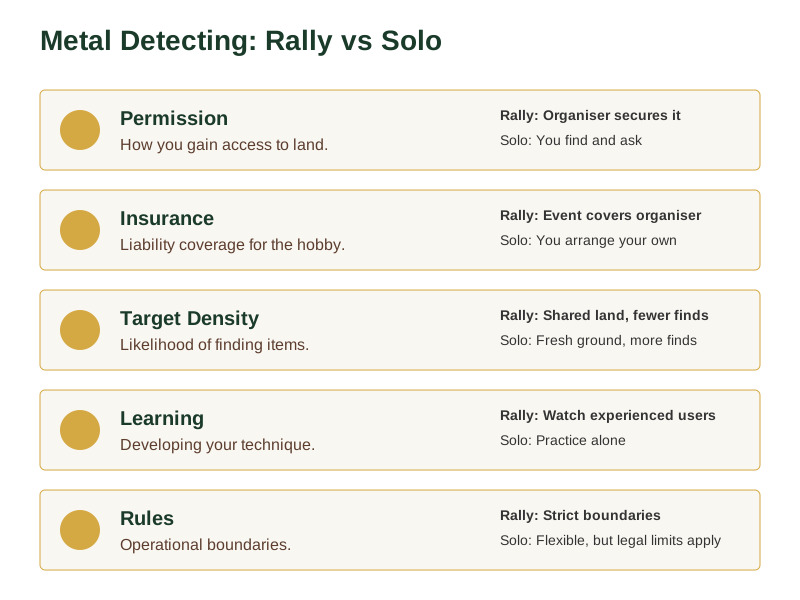
| Aspect | Rally Detecting | Solo Detecting |
|---|---|---|
| Land Access | Pre-arranged by organiser | Self-negotiated |
| Insurance | Personal policy required | Personal policy required |
| Finds Potential | Shared ground, fewer easy targets | Exclusive access, higher target density |
| Learning Curve | Accelerated by observation | Developed through solo practice |
| Flexibility | Follow event schedule and rules | Set your own pace, within legal bounds |
Your first rally: what to do next
If land access issues have stalled your detecting progress, a rally offers a straightforward way to begin. It provides a structured, legally secure environment to build fundamental skills and confidence.
After attending a rally and seeing how your equipment performs in different conditions, you’ll be better equipped to seek independent permissions. You’ll understand exactly what responsible detecting involves and what assurances landowners require.
Get the Free Metal Detecting Permission & Reporting Checklist to ensure you’re properly prepared. Then find a well-reviewed rally, secure your spot, and get ready to make your first proper discoveries.
Further resources
- National Council for Metal Detecting (NCMD)
- Federation of Independent Detectorists (FID)
- Portable Antiquities Scheme
What a rally transmits, that no checklist can, is the hobby’s norms. Hole reinstatement, finds logging, landowner etiquette — these are learned by watching fifty people do them. That apprenticeship by observation is the rally’s real product.
Related Guides
For a complete overview, see our Are Metal Detecting Clubs Worth Joining in the UK? .
This article offers general guidance. For specific legal advice, consult a qualified professional or the relevant official sources.