Metal Detector Coil Sizes: What Each Size Does Well
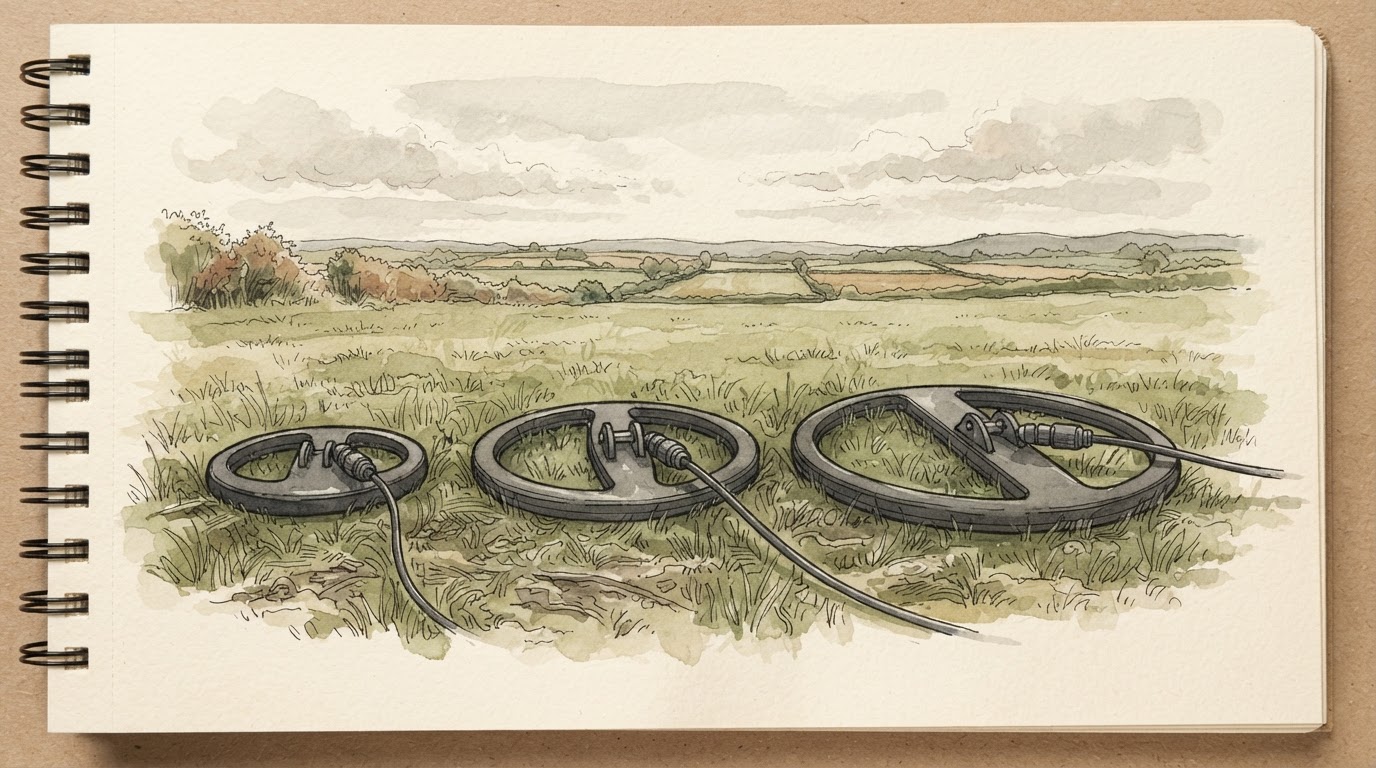
The first step isn’t choosing a coil—it’s identifying whether your detector can accept one. Entry-level machines often have fixed coils with the cable permanently routed through the stem to a sealed control box. In contrast, detectors with interchangeable coils feature a visible bayonet connector or threaded collar at the base of the lower shaft. This physical difference determines whether coil upgrades are even possible.
Once compatibility is confirmed, coil size becomes the main factor controlling how many targets your detector processes at once. In iron-rich UK parks, smaller coils with narrower detection fields prove more effective at isolating coins from nails, trading depth for precision.
Coil designs and their detection patterns
Two main coil designs create distinct detection patterns. Concentric coils generate a cone-shaped field—wider at the surface, narrowing with depth—offering precise identification in clean ground according to manufacturer documentation.
📺 Watch: Nexus Standard MP V3 Concentric Vs Double D Coils - Unmasking — Paul Warren - Metal Detecting
Double-D coils use two D-shaped loops in opposite orientation, creating a narrow elliptical field that sits shallower and flatter. Garrett’s technical guides note this configuration handles mineralised soils better and often provides more uniform depth than concentric coils of equivalent size.
Elliptical coils represent a narrower variant suited for tight spaces and iron-heavy areas. The goal is matching each design’s characteristics to your specific ground conditions rather than seeking a universal solution.
The balanced performer: standard 10-11 inch coils
Most detectors ship with a mid-size stock coil, often around 10-11 inches, representing a practical compromise for general use. These standard sizes provide reasonable depth for coin-sized targets while covering sufficient ground per sweep to maintain hunting efficiency.
The limitation emerges in high-trash environments where the coil’s wider detection field registers multiple targets simultaneously. In iron-heavy ground, this physical characteristic causes the coil to struggle separating coin signals from adjacent junk.
Small coils for problematic ground
Smaller coils don’t detect shallower because they’re inferior—their narrower field is precisely what makes them effective for specific challenges. Where a standard coil might register multiple targets at once, masking valuable signals, a 6-inch coil’s concentrated detection cone isolates individual targets more effectively.
📺 Watch: Simplex + SP24 vs SP28 (Stock Coil). Which performs better? Baz's dilemma tested. — The Simplex Guru
Signal clarity improves noticeably in heavily worked sites. Parks with decades of detecting activity, or ground with substantial iron deposits, often produce confusing tone blends with standard coils. Switching to a smaller coil typically delivers distinct, trustworthy signals where previously there was only noise.
Naturally, trade-offs exist: reduced depth compared to larger coils and slower ground coverage mean smaller coils aren’t everyday replacements. They’re specialist tools for when junk density overwhelms standard coil performance.
What to consider before buying
If you’re considering an additional coil, several practical factors deserve attention. First, confirm compatibility—not all detectors accept interchangeable coils. Some entry-level models feature fixed coils, meaning upgrades require purchasing an entirely different detector.
For the coil itself, multi-frequency models operating across a range rather than a single frequency generally deliver more consistent performance across varied UK soil conditions. Weight impacts usability significantly—a heavier coil alters your detector’s balance and swing dynamics, increasing fatigue during long sessions.
Before spending, review the manufacturer’s warranty terms and determine if a coil protector is included or available separately—the underside suffers abrasion from ground contact, making protectors inexpensive but valuable.
Common questions about coil performance
Do smaller coils detect deeper?
Generally no—larger coils create bigger magnetic fields that penetrate deeper. Smaller coils prioritise target separation and precision in trash-heavy conditions, representing the core trade-off: you gain separation but sacrifice depth.
Are coils interchangeable between detectors?
No—compatibility depends on your detector’s connection type and operating frequency. Some entry-level models have fixed coils, making upgrades impossible without purchasing a new detector entirely.
What’s the best starter coil size?
The stock coil included with most detectors, typically 10-11 inches, represents the ideal starting point. It balances depth and coverage well for general park and field hunting, allowing you to learn your detector’s responses across different conditions.
Quick reference guide
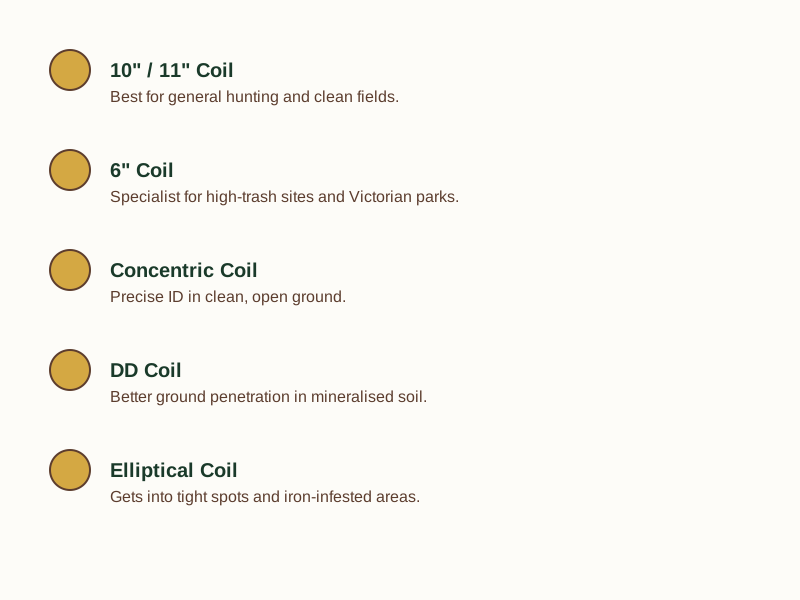
| Coil Size | Best For | Limitations |
|---|---|---|
| 10" / 11" | General hunting, parks, clean fields | Moderate depth, struggles with target separation in trash |
| 6" | High-trash sites, iron-heavy ground | Reduced depth, slower coverage |
| Concentric | Clean open ground, precise identification | Poor mineralised soil penetration |
| DD / Double-D | Mineralised soil, iron-rich environments | Better ground penetration, fine separation |
| Elliptical | Tight spaces, iron-infested areas | Narrower field than equivalent round coils |
Making your decision
The essential trade-off remains depth versus separation. Larger coils reach deeper but struggle with target separation in trash-heavy conditions. Smaller coils sacrifice depth and coverage for clean, isolated signals in junk-filled sites.
For most general detecting on UK parks and common land, your stock 10-11 inch coil serves as the reliable default—keep it fitted until you encounter sites where signals become too confused to trust.
When that happens—working parks with heavy iron contamination or heavily detected commons—switching to a smaller coil typically delivers immediate improvements in signal clarity. Neither size universally outperforms the other; each excels in the conditions that match its design strengths.
Unlike most detector accessories that simply adjust settings, a different coil size fundamentally changes how your machine interacts with the ground—making it one of the most consequential upgrades you can make. Before heading out, ensure you’ve covered permissions and reporting procedures.
Technical resources
Related Guides
For a complete overview, see our Coil Size Explained: Which Is Best for Your Soil and Target? .
Always verify specific technical specifications with manufacturers and legal requirements with official sources.