Why Is My Metal Detector Not Finding Anything?
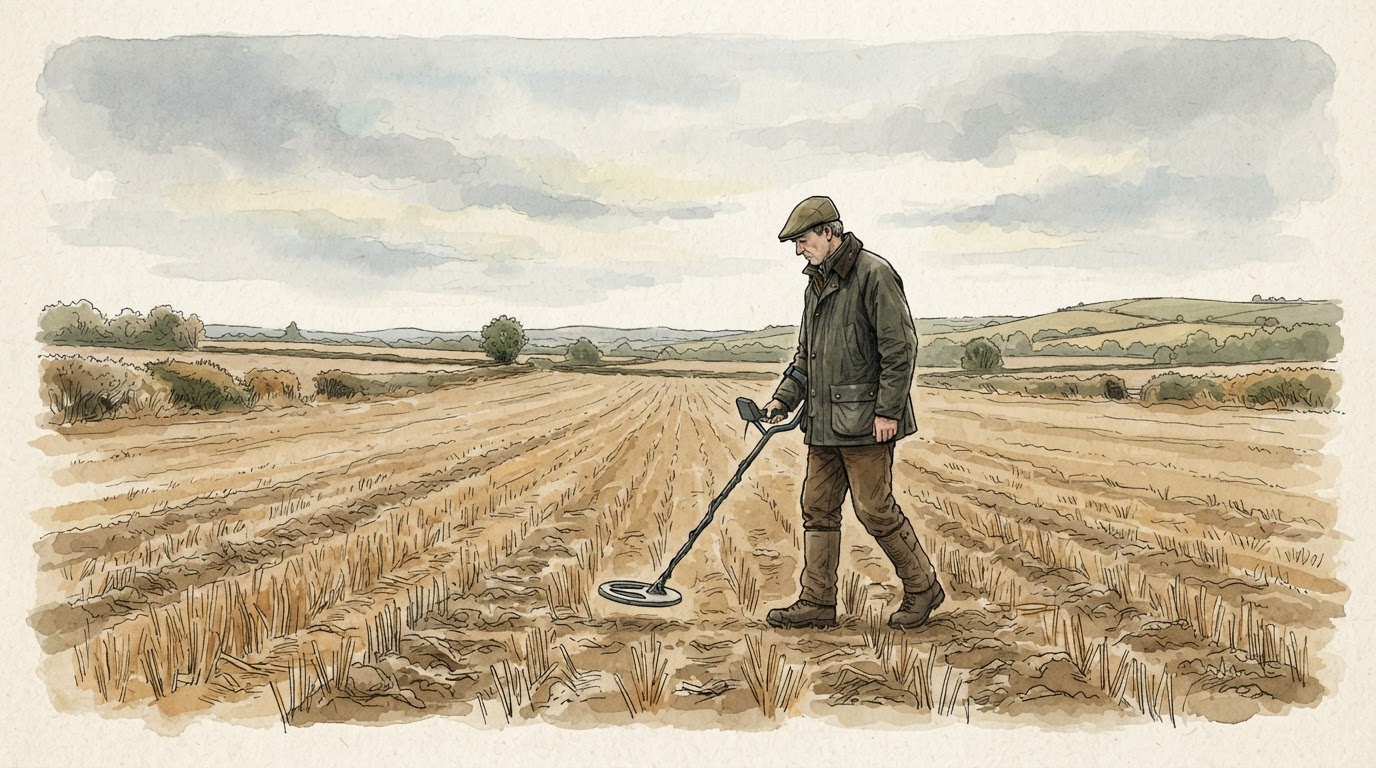
A detector that produces no signals at all on a known productive site tells the operator something specific: the issue lies with the setup, not the ground’s potential. The sequence of likely causes—starting with the discrimination setting, then ground balance, and finally coil overlap—forms a diagnostic path that can be run through in the field before considering equipment failure.
This guide covers these systematic checks in order, from the most common permission oversights to the subtler technique adjustments that restore detection capability.
Your First Check: Legal Access and Permissions
Begin by confirming your legal standing. In the UK, the right to walk on land—whether via a public footpath or on access land designated under the Countryside and Rights of Way (CRoW) Act 2000—does not grant the right to use a metal detector. The CRoW Act created public access rights for recreation, but these rights explicitly exclude metal detecting. You still need explicit permission from the landowner or relevant authority.
📺 Watch: Get permission to metal detect - Finding Hidden Treasure — TheManWithTheHat
Without this authorisation, detecting can constitute trespass. The National Council for Metal Detecting (NCMD) code of conduct stresses the importance of obtaining written or clear verbal permission first.
When a significant discovery is made with proper permission, the Treasure Act 1996 requires reporting finds that meet its specific criteria to the coroner within 14 days. This applies to certain precious metal objects, coin groups, or items of historical importance. The Treasure Act reporting process applies only to objects satisfying the statutory definition.
Adjusting Detector Settings That Mask Signals
With permissions confirmed, focus on your machine’s configuration. Settings are the most frequent cause of silence, especially ground balance mismatches in variable UK soils.
Discrimination Setting – Set too high, this filter can eliminate desirable targets along with trash. Aggressive discrimination beyond the iron range might filter out small hammered coins and low-conduction objects. Many detectorists start with minimal discrimination to learn their machine’s signal responses.
Ground Balance – This is the primary setting for handling mineralised soil. Whether your detector has manual or automatic ground balance, it must be calibrated for the specific ground you’re on. A mismatch here can cause the machine to ‘see’ only ground noise, effectively silencing it to actual targets.
Sensitivity – While high sensitivity increases depth, setting it too high can cause the detector to process excessive environmental noise, masking targets. On many machines, starting with a moderate setting and increasing it gradually yields better results than beginning at maximum.
A simple field test involves burying a coin from your pocket in the local soil. If the machine doesn’t signal over this known target, your settings need adjustment. A normal beep confirms the equipment is functional.
Improving Your Sweep and Coil Control
Your physical technique has a direct impact on what the detector can ‘hear’.
Sweep speed is critical. Moving the coil too quickly means the machine lacks sufficient time to process a signal before the target is passed. An excessively slow sweep can introduce unnecessary ground noise. A steady, deliberate pace with a slight overlap between passes is the goal.
Keep the coil close to the ground without dragging. Beginners often hold the coil several inches high, significantly reducing detection depth for smaller or deeper targets. In trash-heavy areas, slower sweeps with tighter patterns often prove more effective than wide, fast arcs, trading coverage for accuracy.
Verifying Hardware Integrity
Before suspecting a mechanical fault, run through these basic hardware checks. Most ‘faulty’ detectors have simple, correctable issues.
Check in this order:
- Headphone connection: A loose plug is a common cause of complete silence.
- Battery status: Verify fresh batteries are installed with correct polarity.
- Coil connection: Ensure the coil cable is firmly attached to the control box.
- Coil condition: Inspect the coil cable for visible damage, especially near connectors.
If the machine passes these checks but remains silent, conduct the known-target test. If it signals for a test coin but not in the field, the equipment works—the issue is environmental or settings-based.
Common Problems and Resolutions
| Issue | Typical Symptom | Action to Take |
|---|---|---|
| Lack of permission | No signals on unchecked land | Secure written landowner permission |
| Incorrect ground balance | Overwhelmed by mineralised soil | Calibrate for the specific ground |
| High discrimination | Small targets filtered out | Start with minimal discrimination |
| Sensitivity too high | Target masking through noise | Begin moderately and increase gradually |
| Poor sweep technique | Targets missed due to speed | Use a steady, overlapping sweep |
| Hardware fault | Complete silence | Check batteries, headphones, connections |
📺 Watch: Ground Balance For Depth And Stable I.D — History Revisited Metal Detecting Tips
Answering Key Detection Questions
What are the rules for detecting on UK beaches?
Beach detecting is generally permitted but requires checking specific local rules. The Crown Estate allows metal detecting on its foreshore without formal consent, though its terms and third-party rights may apply. Some local authorities have their own regulations for particular beaches, so always verify with the relevant authority before starting.
Is reporting required for every find?
Only finds meeting the Treasure Act 1996 criteria must be reported—these are objects with specific precious metal content, coin groups, or items of historical significance. The ownership of non-treasure finds is typically governed by your agreement with the landowner. Recording all finds with the Portable Antiquities Scheme is good practice, contributing to archaeological knowledge regardless of legal obligation.
Why is my detector beeping constantly?
Continuous beeping often indicates the detector is reading high soil mineralisation rather than actual targets. This is common in mineralised ground, especially after rain or on clay soils. Adjusting the ground balance or reducing sensitivity usually resolves it. If beeping continues, try slower sweeping or a different location.
Moving Beyond the Silence
A detector that finds nothing is frustrating, but it rarely means the equipment is broken. The typical culprits—permissions, settings like ground balance and discrimination, and technique—all have solutions. Follow the logical sequence: confirm your legal standing, adjust the machine for the conditions, refine your sweep, and verify the hardware.
If issues persist after these checks, tap into local knowledge. Detecting clubs or experienced detectorists familiar with your area can offer ground-specific advice. Your local Finds Liaison Officer is also a valuable resource.
The troubleshooting sequence outlined here also serves as a useful pre-session checklist. Running through permissions, settings, and hardware checks before the first swing prevents the most common causes of a silent hunt, saving time and frustration in the field.
For clear guidance covering permission essentials and Treasure Act thresholds, our free checklist provides the logical next steps.
Get the Free Metal Detecting Permission & Reporting Checklist
Official Sources and Further Reading
- Countryside and Rights of Way Act 2000
- National Council for Metal Detecting (NCMD)
- Portable Antiquities Scheme (PAS)
Related Guides
For a complete overview, see our Why Does My Metal Detector Keep Giving False Signals? .
This article offers general guidance. Always verify specific legal requirements and technical procedures with official sources or qualified professionals.