How to Start Metal Detecting in the UK (Without Getting Banned)

As an Amazon Associate we earn from qualifying purchases. Some links on this page are affiliate links, which means we may earn a small commission if you make a purchase.
Before you can legally swing a detector for the first time, there’s a sequence of decisions to make. First, identify a suitable site, then establish who owns it. Next, you must approach the landowner and agree terms in writing. Crucially, you must also check the site isn’t a scheduled monument. This procedural checklist is the real entry point to the hobby, not just a set of abstract rules.
Quick picks
- Multi-frequency starter? Minelab Vanquish 340 — light, handles wet sand better than single-frequency. Check Amazon price →
- Simplest controls? Garrett Ace 200i — parks, gardens, easy farmland. Check Amazon price →
- Waterproof inland value? Nokta Simplex Ultra — not the salt-beach pick. Check Amazon price →
- Recovery tool first? Garrett Pro-Pointer II — splashproof, inland favourite. Check Amazon price →
All land has an owner. The hobby operates within a clear legal structure defined by landowner consent, the Treasure Act 1996, and a strong ethical code. Ignoring these elements risks prosecution, land bans, and damage to the hobby’s reputation. Getting it right means you can enjoy a pastime that landowners are willing to support.
This guide covers the essentials: where detecting is legally permitted, your duties when you find something, responsible field conduct, and the gear that delivers genuine value. While regulated, metal detecting becomes deeply rewarding once you master the rules.
Your First Steps: Land Access and Legal Reality
Explicit permission from the landowner is mandatory for metal detecting on any UK land. This includes areas beginners often mistake as free-for-alls: public parks, common land, woods, and footpaths. Trespassing with a detector is a civil offence.
Identify the correct person to ask. If land is tenanted, you need consent from both the tenant and the freeholder. One approval alone is insufficient.
Certain sites are strictly off-limits without specific authority. Detecting on a scheduled monument is a criminal offence under the Ancient Monuments and Archaeological Areas Act 1979. The same applies to Sites of Special Scientific Interest (SSSI) and Ministry of Defence land. Violations can lead to prosecution, equipment confiscation, and a criminal record.
Strengthening your permission request
Before approaching a landowner, joining a recognised detecting organisation is a smart move. Membership with the National Council for Metal Detecting (NCMD) or the Federation of Independent Detectorists (FID) includes public liability insurance. This cover demonstrates responsibility and can improve your chances of getting a ‘yes’.
Coastal detecting rules
While many beaches managed by The Crown Estate and in Scotland are open to detecting, local bylaws can impose restrictions. Always verify the status of a specific beach before travelling. The Crown Estate website provides guidance, but assumptions can lead to problems.
Ready to get your paperwork in order? Download the Free Metal Detecting Permission & Reporting Checklist to ensure you’ve covered all bases before your first outing.
Handling Finds: The Treasure Act and Reporting Duties
The Treasure Act 1996 establishes the legal process for finds in England, Wales, and Northern Ireland. Compliance is not optional.
Treasure is defined by specific criteria, primarily covering gold and silver objects, or groups of coins, over a certain age. Recent cases have included Bronze Age hoards and Viking artefacts. The definition has been expanded to include objects of significant historical or archaeological importance, so it’s important to stay informed.
If you discover a potential treasure item, you are legally obliged to report it to the local Finds Liaison Officer (FLO) or directly to the Coroner. Detectorists contribute significantly to the archaeological record through responsible reporting.
For finds that don’t qualify as treasure—a solitary coin, a button, a piece of lead—different rules apply. In England, Wales, and Northern Ireland, the landowner generally owns any item found on their property unless a prior written agreement states otherwise. Significant non-treasure finds should still be reported to the FLO via the Portable Antiquities Scheme (PAS), which helps build a comprehensive archaeological record.
The reporting process breaks down simply:
- Treasure finds: Report to the Coroner.
- Other archaeologically interesting finds: Report to the local FLO or via the PAS website (finds.org.uk).
While most discoveries won’t be treasure, recording them contributes valuable historical data. A single Roman coin provides clues about past activity, even if it has no legal status.
Conduct and Ethics: The Countryside Code
Your behaviour in the field directly impacts the hobby’s reputation. Adhering to a few simple principles ensures continued access for everyone.
Excavate carefully and reinstate the ground meticulously. This isn’t a suggestion; it’s a requirement every single time.
Unfilled holes pose a serious risk. Livestock can step into them and sustain leg injuries, potentially leading a landowner to ban all detectorists permanently.
The NCMD Code of Conduct provides full details on responsible practice. The essence is to leave no trace. Replace turf neatly and ensure the area looks undisturbed.
Remove any rubbish you uncover. Modern debris like bottle caps and wire are common. Take them away for proper disposal; never leave them on site.
Adhere to the Countryside Code. Close gates, avoid blocking access points, respect crops and wildlife, and keep dogs under control. Conduct yourself as a welcome visitor.
On farmland, discuss timing with the landowner. Detecting is not permitted in fields with standing crops. Harvested fields are usually acceptable, but always confirm, including access routes. A brief conversation prevents misunderstandings.
Essential Accessories: Pinpointers, Tools, and Headphones
With permissions and ethics covered, your choice of accessories becomes clearer. Focus on items that provide genuine utility.
📺 Watch: Pin Pointer Tip - Extremely Useful when Metal Detecting! — Coils and Coins Detecting
Pinpointers
A pinpointer drastically reduces target recovery time by locating the exact spot after your main detector gives a signal. It’s a worthwhile investment for regular use.
The XP MI-6 (paid link) offers premium integration for owners of XP detectors like the Deus, ORX, and Deus II. Its wireless connectivity to XP detectors is its main selling point, though it represents a significant investment compared to basic models.
See XP MI-6 on Amazon → (paid link)
The Garrett Pro-Pointer II (paid link) is a reliable, budget-conscious option. It’s straightforward and well-built. The downsides are its lack of full waterproofing and fixed sensitivity. It is perfectly adequate for typical UK conditions like parks and pasture.
View Garrett Pro-Pointer II on Amazon → (paid link)
For most beginners, the Pro-Pointer II represents the best value. The MI-6 is a sensible choice only if you are committed to the XP ecosystem and value wireless convenience.
Digging Tools
The right tool extracts targets efficiently without causing unnecessary disturbance. Options range from full-sized shovels for tough ground to hand tools for precision.
The Lesche 31 (paid link) is a robust, purpose-built shovel favoured by those working frequently in challenging conditions like hard clay. It can make digging in difficult soils more efficient. The trade-off is its weight, which can sometimes cause interference when carried near the detector coil.
View Lesche 31 on Amazon → (paid link)
The Spear & Jackson Hori Hori (paid link) is a versatile, affordable multi-tool capable of digging and cutting roots. It serves well for light-duty work but isn’t a replacement for a dedicated shovel in heavy soil.
See Spear & Jackson Hori Hori on Amazon → (paid link)
A practical approach is to begin with a sturdy hand digger and a simple garden spade. Upgrade to a specialist tool like the Lesche if you regularly encounter demanding ground.
Headphones
Headphones improve concentration by blocking ambient noise and conserve detector battery power. They are a useful addition for serious hobbyists.
The Garrett MS-2 (paid link) is a comfortable, value-oriented choice. The padded design suits long sessions, and the closed-back cups take the edge off wind noise. For use with Garrett detectors, it’s a straightforward and reliable option.
View Garrett MS-2 on Amazon → (paid link)
The XP WSAUDIO (paid link) provides wireless convenience for XP detector users, eliminating cable tangles. This enhances comfort during long sessions. The drawbacks include a reliance on battery power, requiring pre-session charging, and its proprietary nature limits use to XP equipment.
View XP WSAUDIO on Amazon → (paid link)
For beginners, the MS-2 offers a solid balance of affordability and performance. The WSAUDIO is best suited to XP users who prioritise wireless freedom.
Selecting Your First Detector
If you’re still choosing a machine, these entry-level models represent different approaches to starting the hobby.
The Minelab Vanquish 340 (paid link) is user-friendly, light, and offers good value. Its multi-frequency technology handles varied UK ground conditions well, including wet sand. Limitations include the lack of a dedicated pinpoint mode and a control box that isn’t waterproof.
The Garrett Ace 200i (paid link) is a simple, robust detector ideal for absolute beginners. Its controls are intuitive, allowing new users to start detecting quickly. It struggles in mineralised ground and has limited advanced features, making it best suited for parks, gardens, and easy farmland.
Check Garrett Ace 200i price → (paid link)
The Nokta Simplex Ultra (paid link) offers performance beyond its price. It’s easy to learn and well-built. Being a single-frequency machine, it can be less stable on wet salt beaches compared to multi-frequency detectors. For inland fields, parks, and dry sand, it represents excellent value.
Check Nokta Simplex Ultra price → (paid link)
The best choice depends on your circumstances. The Ace 200i is the simplest start. The Simplex Ultra offers more features for the money if you’re willing to learn. The Vanquish 340 provides multi-frequency performance with some operational trade-offs.
Buy Minelab Vanquish 340 on Amazon → (paid link)
Whichever machine you start on, the coil bolted to the end of it shapes what you actually recover — see which coil size suits your soil and targets .
Common Questions Answered
Is beach detecting allowed?
Often, yes. Many Crown Estate and Scottish beaches permit detecting without needing individual landowner permission. However, local restrictions can apply, so always check specific beach regulations before you visit. What’s allowed in one location may not be permitted in another.
What should I do with a single Roman coin?
A lone Roman coin is not usually classed as treasure. You should inform the landowner, as they typically own such finds. Reporting it to the Portable Antiquities Scheme is also recommended for archaeological recording. If the coin is part of a group or hoard, it may qualify as treasure and must be reported to the Coroner. When uncertain, report the find.
Is cleaning finds advisable?
Avoid cleaning any finds. Scrubbing or cleaning can damage the surface patina and remove soil evidence that experts use for identification and dating. What looks like dirt to a beginner might be critical information for a specialist. Leave cleaning to conservation professionals after the find has been properly assessed.
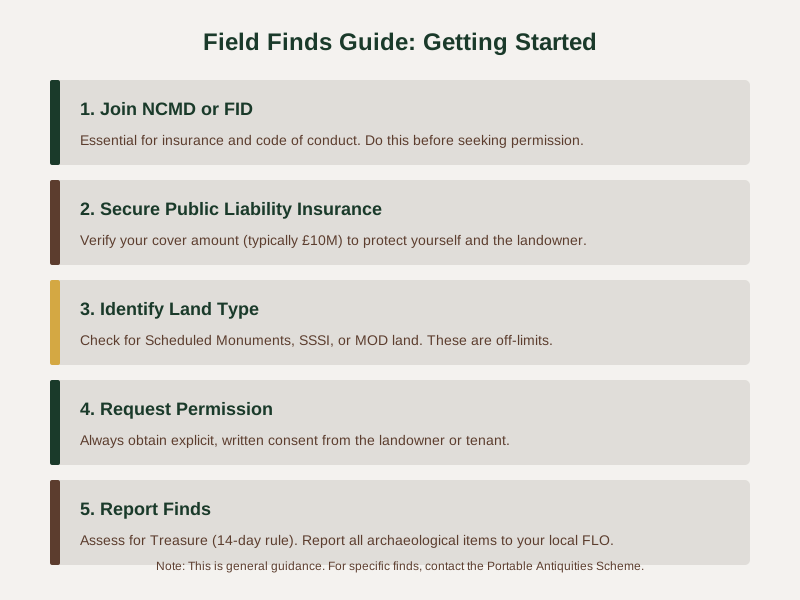
UK Metal Detecting Permission & Reporting Checklist
| Step | Action | Deadline / Note |
|---|---|---|
| 1 | Join NCMD or FID | Before asking permission |
| 2 | Secure Public Liability Insurance | Verify cover amount |
| 3 | Identify Land Type | Check for Scheduled Monuments, SSSI, MOD |
| 4 | Request Permission | Get written consent from landowner/tenant |
| 5 | Find Assessment | Determine if item is Treasure or non-treasure |
| 6 | Report Find | Treasure to Coroner, others to FLO/PAS |
Your Next Move
The checklist linked below is designed to be taken into the field, not just read at home. It’s a working document for the first conversation with a landowner and the first find that raises a reporting question.
Get the Free Metal Detecting Permission & Reporting Checklist
As an Amazon Associate we earn from qualifying purchases.
Related Guides
For a complete overview, see our Do You Need Permission to Metal Detect in the UK? The Complete Legal Guide .